
Show Notes
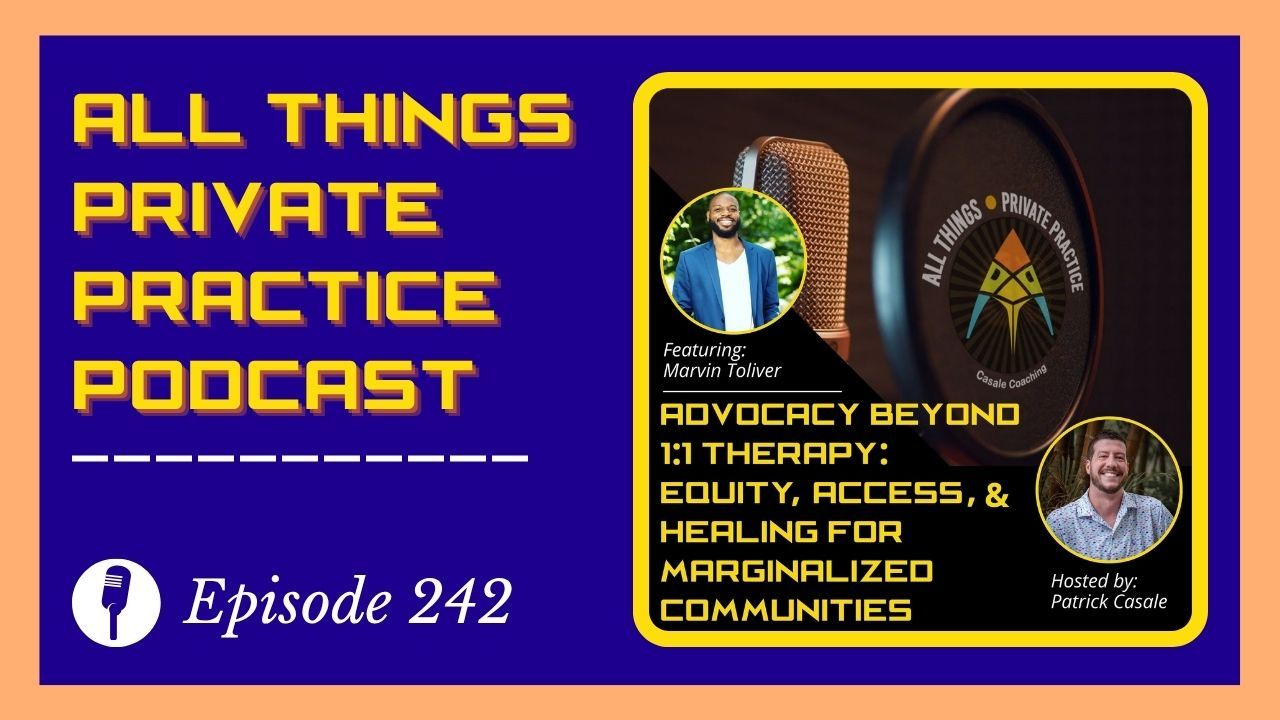
In this episode, Patrick Casale talks with Marvin Toliver, LCSW, TEDx speaker, and founder of Dear Black Man, You Good?, about the realities of mental health work, decolonizing therapy, and building healing communities outside of traditional systems.
3 Key Takeaways:
- Reclaim Your Accomplishments: As Marvin emphasized, marginalized clinicians are often taught to shrink themselves—owning your achievements creates space for others to see what’s possible.
- Therapist Sustainability is Essential: The mental health field can leave therapists depleted, and viewing burnout as a sign of systemic issues—rather than personal failure—is so important. Therapy shouldn’t cost you your well-being.
- Healing Goes Beyond the Office: Community-centered approaches and peer-led spaces (like Marvin’s men’s groups and the Train the Trainer Academy) acknowledge that powerful healing can happen outside of conventional therapy rooms.
More about Marvin:
Marvin (he/they) is a licensed clinical social worker (LCSW), speaker, and movement worker based in Philadelphia with over ten years of experience in mental health, community healing, and group facilitation. He is the owner of Reimagine Culture, LLC and founder of the nonprofit Dear Black Man, You Good?, where he advances decolonized and community-centered approaches to care. Marvin is a TEDx speaker and was featured as a cycle breaker in The Color of Care, a documentary produced by Oprah Winfrey. His work is grounded in reimagining mental healthcare beyond systems rooted in white supremacy.
- Website: marvintoliver.com
- Instagram: instagram.com/mtoliver_lcsw
- Instagram: instagram.com/reimagineculture_llc
🎙️Listen to more episodes of the All Things Private Practice Podcast here
🎙️Spotify
🎙️Apple
🎙️YouTube Music
▶️ YouTube
✈️ Check out available Retreats
🗨️ Join the free Empowered Escape FB Community
🗨️ Join the free All Things Private Practice FB Community
A Thanks to Our Sponsors: The Receptionist for iPad, Alma, & Portland, Maine, Summit 2026!
I want to thank The Receptionist for iPad for sponsoring this episode.
The Receptionist for iPad is a HIPAA-ready digital check-in system that eliminates the need to walk back and forth from your office to the waiting room to see if your next appointment has arrived. Clients or patients can check in for their appointments, and you'll be immediately notified by text, email, or your preferred channel. Break free from interruptions and make the most of your time, because it is valuable. Start a free 14-day trial of the Receptionist for iPad by going to thereceptionist.com/privatepractice. Make sure to start your trial with that link to get your first month free if you decide to sign up.
✨Alma
Thanks to Alma for sponsoring this episode.
Alma empowers you to confidently accept insurance backed by an all-in-one EHR that simplifies scheduling, documentation, and day-to-day practice operations. With a network of engaged providers and free CE courses, Alma makes it easy for you to build the practice of your dreams on your terms. Alma believes that when therapists get the support they need, mental healthcare gets better for everyone. Learn more at helloalma.com/ATPP.
The 2026 Doubt Yourself Do It Anyway Summit is happening for the first time in the United States in beautiful Portland, Maine, on September 1st–3rd, 2026. Portland, Maine, is a beautiful coastal city in the Atlantic Ocean. There's a lot of history there, and it's a very funky, creative, safe, walkable, diverse, and progressive city. You will get 9 NBCC CEs. We have ASWB pending—we'll make an announcement when that's finalized—and have 13 prolific industry leaders. This summit has always been about showing that our skills are applicable in so many different ways, and to motivate you to think bigger, grow in this profession, take more risks, work through self-doubt, and really embrace the doubt-yourself-do-it-anyway mentality. Spots are limited. Reserve your spot here: empoweredescapes.com/portland-maine-summit
Doubt yourself. Do it anyway. See you in Maine.
Free Gifts for Our Listeners
Get a practical podcasting workbook for therapists considering starting a podcast, created by Patrick Casale, host of the podcasts All Things Private Practice and Divergent Conversations.
You'll get a practical structure for therapists who want to start a podcast but don’t want to rush, perform, or build something they can’t sustain.
Grab your free copy: atppod.com/free-podcasting-workbook
✨ Move Beyond Private Practice As A Neurodivergent Entrepreneur
Move Beyond Private Practice As A Neurodivergent Entrepreneur is a FREE 5-part mini-course designed for therapists who want sustainable financial independence beyond one-on-one work.
Access your free mini-course here: atppod.com/move-beyond-private-practice-free
Transcript
PATRICK CASALE: Hey, everyone. Welcome back to the All Things Private Practice podcast. I'm joined today by Marvin Toliver, who is a licensed clinical social worker, speaker, I should add, TEDx speaker, and movement worker based in Philadelphia with over 10 years of experience in mental health, community healing, and group facilitation.
He is the owner of Reimagine Culture LLC and founder of the nonprofit, Dear Black Man, You Good? Where he advances decolonizing community-centered approaches to care. Marvin is a TEDx speaker and was featured as a Cycle Breaker in the Color of Care, a documentary produced by Oprah Winfrey. His work is grounded in reimagining mental health care beyond systems rooted in white supremacy.
Really excited to have you on, man. I love your content. I've been following you for a long time on Instagram, specifically, just watched your TEDx. And what you've done is unbelievably impressive. So, thank you for making the time to come on here and sharing a little bit of your story.
MARVIN TOLIVER: Yeah, thank you. Thank you for having me. Every time I hear my bio back, I'm like, “Is that me? [INDISCERNIBLE 00:02:23]? That's cool.”
PATRICK CASALE: Man, how does that feel to, like, receive that? I personally really hate having my bio read, but it's just my own shit.
MARVIN TOLIVER: Yeah, I always get a little bit uncomfortable, but it's also something that I've started to lean into. So, any conference that I speak at, my second or third slide is always like a list of my accomplishments.
And I do that because a lot of us, especially like black folks, especially marginalized folks, especially women, are taught to shrink ourselves a lot. And so, you know, a lot of us have so many amazing accomplishments, and accolades, and different things, but we just keep them to ourselves because we're taught to be smart. I'm like, no, you're going to, you're going to know about everything, not every little thing. But I've done a lot of really cool, really dope shit. And like, people are going to know about it.
PATRICK CASALE: Yeah, yeah. I love that. And I've had a couple of other really, really cool black therapists and professionals on here before, who own that shit to know, like, I'm going to stand 10 toes down on this. Like, I want to make sure, if I can't even feel proud about it, that other people around me can acknowledge that it exists and that it can be a possibility.
MARVIN TOLIVER: Right.
PATRICK CASALE: Dr. Dominique Pritchett, someone who comes to mind immediately, I don't know if you're familiar with her work, but her bio page is like, you know, endless. And I read it through it. And I'm like, “Damn, this is so impressive.” But I love that perspective, so I appreciate you sharing it that way.
That's a good transition point, by the way. Like, I know we don't really know what we're going to talk about, which I personally love.
So, when I started this business six years ago, and all the things that I've created along the way, it was always talking about impostor syndrome and self-doubt. And throughout that journey, I realized, like, for a lot of people who are marginalized with any sort of intersecting identity, impostor syndrome is complete bullshit. It's just colonization and supremacy culture, right? Because if that narrative is constantly like, you're not good enough, you don't deserve to be here, we just let you be here. Of course, that mentality shifts to like, “Okay, I do need to shrink myself. I do need to play small.”
MARVIN TOLIVER: Yeah, I've stopped using the term impostor syndrome and start calling it internalized white supremacy.
PATRICK CASALE: Yeah.
MARVIN TOLIVER: I think that's really what it is. And even I just had a podcast with someone else, and they are starting to call it white supremacy, white narcissism. And I was just like, “Ooh, okay.”
But yeah, I think, you know, a lot of marginalized folks have been pushed out and not allowed in so many spaces that they… If someone treats you a certain way for so long, but after a while, you start to believe it.
And so, I think that is what has happened on a massive, a massive, massive scale. And I'm all about reclaiming it, like reclaiming our voices, reclaiming our confidence, reclaiming our power as marginalized folks.
And so, yeah, so it goes in direct opposition to white supremacy, to capitalism, to patriarchy, everything that I kind of stand for now, which I think a lot of people confuse being a capitalist with surviving capitalism. And many of us are surviving capitalism. Like, if there was another option, we’d choose something else.
PATRICK CASALE: Yeah, yeah, yeah.
MARVIN TOLIVER: But since this is what we are in, like, we have to survive it. And we got to do what we got to do to survive, you know?
PATRICK CASALE: That's such a good delineation and distinction, because those two are so different, right?
MARVIN TOLIVER: Mm-hmm (affirmative).
PATRICK CASALE: Like, surviving capitalism is hellacious. It's exhausting. And I think that can help feed that mentality of, like, grind and hustle culture of like, I’ve to do this, I've got to do this, I've got to create, I've got to be out there, I've got to be putting all these projects into the world. And it's because your system has fully realized that, like, this is the only way I survive in this culture, right? Is like, I have to pay my bills, I have to take care of my needs, I have to take care of my medical needs, like, and that shit is so fucking exhausting.
MARVIN TOLIVER: Yeah, yeah. Everything costs money. Every single thing costs money. And so, it's like, okay, I can try and not be a capitalist, but like, you’re going to have a hard time.
PATRICK CASALE: Yeah, yeah, 100%. And deconstructing that of trying to figure out ways to create equitability and accessibility, and show up with your values while simultaneously taking care of yourself. And I don't think that this profession does a great job of supporting you in that journey.
MARVIN TOLIVER: Yeah, are you social work? LPC?
PATRICK CASALE: LCMHC, so, a mental health counselor, yeah.
MARVIN TOLIVER: Yeah. I mean, it doesn't matter who I talk to, really, from psychology to LPC, social work, many of us are not taught, one, how to take care of ourselves in this field. And two, how to work smarter and not harder.
I think it's like, “Oh, you're expected.” Like, we know we're not going to make a lot of money as a social worker, which is like, “Well, maybe.” But also, if you learn how to be creative with kind of your skills, with understanding business, understanding social media, if folks choose to participate in AI, how to understand AI, you could do some really cool things with [CROSSTALK 00:07:51].
PATRICK CASALE: Yeah, yeah. It's almost like a running joke, right? In grad school, where your professor’s kind of joke about the fact that you didn't get into this field to make money. I remember that being like a constant theme that was always stated by multiple professors. And I you buy into that. You also kind of get taught, in a way, to embrace that shame culture of if I am going to make money, then I am bad, or that I'm no longer helpful, or I'm no longer aligned with the values of the profession, and the profession is rooted in white Christian saviorism.
MARVIN TOLIVER: Yeah.
PATRICK CASALE: So, the reality is that this profession has been pretty toxic in a lot of ways for generations, and burning people out to no degree, because, like, if you are constantly taught the only way to be in this profession is to give all of yourself away in service of others, what the fuck is that doing for you in the long run?
MARVIN TOLIVER: Yeah, and what do you have left?
PATRICK CASALE: Yeah, yeah.
MARVIN TOLIVER: I was just talking to some colleagues, friends. They were colleagues, they're now friends, just about this profession. And we kind of talked about, like, how long do you really think people should be in this profession?
And I said, no longer than 15 years. If you can get out earlier than do it. And obviously, depending on the type of work and the type of population. I worked in violence prevention, so working with folks that were shot, stabbed, and assaulted, right? So, like, if you're in that for 15 years, I would say maybe 10, for that.
If you're working in, like, I don't have to name all of the disciplines. We know kind of the areas and the populations that are going to be a bit more challenging versus, I don't want to say easier, but I'll just say a different set of issues that require us to show up in different ways.
But being in this field for 20, 30 I have zero interest in that, because this is, and I know therapists are going to understand, and sometimes folks that aren't don't understand. But I think that the assumption is that we’re just talking to people, right? That's definitely what we're doing, is we're just talking to people.
And there's so much more that happens, right? And there's so many things that, like, we actually don't get taught that happens, for some of us, anyway. You know, I'm a relational therapist, and so, like, being aligned, and being really… The only way I can describe it is like, energetically connected to the human, or humans across from me, or on video, is key. Like, this connection is key.
And when you're aligned in that way, when you're like, in it, as a therapist, you're also bringing your energy into it as well. So, yeah, forget like what we learned in grad school, forget theories, interventions, all these other things, like you are literally giving a part of like yourself to this, in this 15-minutes, an hour, however long it is.
And so, so that alone, then along with everything else we're doing. We're recalling past experiences. We're recalling stuff from grad school. We're recalling theory. We're making connections. We're, you know, trying to remember the ex-partner’s dog that [INDISCERNIBLE 00:11:12], right? It's like, it's so much. And after a day, I would come home exhausted, because I do this work… I was working at a at a K-8 with high traumatized population, and then coming home, and doing three or four sessions after that.
And so, my partner at the time was, “Don't talk to me. I don't want to hear anything. I just want to sit down.”
PATRICK CASALE: Yeah, yeah.
MARVIN TOLIVER: And if your days are every day like that, that's not sustainable for anyone.
PATRICK CASALE: It is not, and it is so isolating as well, because you come home from that day, you're cognitively overloaded, energetically depleted, maybe somewhat demoralized by what you've heard that day and what you've had to absorb.
And that absorption gets underplayed, because exactly what you said, if you just think the profession is simply just talking and listening, active listening, sitting with therapeutic silence, building rapport, having that connection, energetically absorbing. I knew very early on, like, I haven't practiced since 2022 because I've had multiple major throat surgeries. The last one paralyzed my vocal cord and like, I just knew it was over for me.
But like, as an autistic ADHDer, I absorb so much energy all the fucking time, and sitting in proximity in relation to people, because I was absorbing it so intensely, I was like, by the time I came home, I had that glazed over look in my eyes. My wife would come home and be like, “You want to talk about something?” I'm like, “I want to watch Lord of the Rings on repeat.”
MARVIN TOLIVER: Give me the office again for the 20,000th time, please [CROSSTALK 00:13:00].
PATRICK CASALE: Exactly. And you are so right that it is not sustainable in a long-term way. And I think that can create such an enormous amount of guilt and shame for people to acknowledge, like, I got into this profession, but maybe this profession is not going to work for me long term. Maybe I put all this like money, energy, loans, all the things that came with the experience, and it's just not a long-term sustainable option. And I think that creates a lot of grief inside people as well.
MARVIN TOLIVER: Absolutely, to your point, like, I think there's a bit of shame, because we've had this narrative of, like, okay, this is a selfless profession. Cool. I'm doing it, right? I'm choosing to not make money. I'm choosing to be in the selfless profession. I'm choosing to intentionally get in the way of someone else's harm for the betterment of their healing. I'm choosing to do this.
PATRICK CASALE: Yes.
MARVIN TOLIVER: Now, all of a sudden, I'm like, “It is too hard.” And then, other therapists that we know and see love it, right? “Oh, I love my job, and I've been doing this for 20 years.” And so, now we're feeling like, “Oh shit. Like, am I bad? Am I not doing enough?”
PATRICK CASALE: Exactly. How many of those therapists do you think are actually telling the fucking truth? I love [INDISCERNIBLE 00:14:18]. I don't buy it. I mean, maybe they love parts of it, but like, there's a lot of struggle in this profession.
And this is a take I've had for a long time, and I believe this to be true, that a lot of us get into this profession to heal parts of ourselves through the work that we do. And if you do not do the fucking work simultaneously, not only will you burn out, you will create so many codependent relationships within your therapeutic sessions and alliances that, ultimately, you're doing more harm than good and trying to heal yourself through the work you're doing while ultimately impacting people's livelihoods.
MARVIN TOLIVER: Yeah, yeah. Ooh, yeah. A while ago, I said, if you are a therapist and you're not in therapy, get in therapy. I don't want to hear any excuses. And I always am just like, you know, I would never tell someone to do a thing or engage in a thing that I've never done myself.
PATRICK CASALE: For sure.
MARVIN TOLIVER: Right? And as a therapist, being in therapy was so helpful for me, because my first two therapists, one in Miami, then one in Boston, were both white women.
PATRICK CASALE: Right.
MARVIN TOLIVER: The first one was kind of your more traditional. The second one was like, okay, like, I see where you're coming from. I still bullshit you, because I'm not ready to talk about my shit yet, but I'm still going to bullshit you, but you're a better example of the tips.
And then, it wasn't until I came to Philly, and I had a Latinx woman who actually started with us in couple’s therapy, I believe, and then that relationship didn't move further, but I kept on with her. And she just spoke to me in my language. Like it was just very much conversational. And there weren't like, well, “Freud said.” I don’t know the fuck about Freud, it’s me, right now, today. How can you help me now?
PATRICK CASALE: Exactly, exactly.
MARVIN TOLIVER: Yeah. And so then, like, I think being in therapy helped me figure out, oh, like, I don't want to be like those therapists, but I do want to be like this therapist. But also, there are parts of me that I need to also kind of figure out how to blend into this. And it all comes with practice. But if had I never engaged in therapy myself, I just think I'd be a very different therapist.
PATRICK CASALE: 100%. I think if you come across therapists that have not been in therapy or don't prescribe to it, that's a fucking red flag for me.
MARVIN TOLIVER: Absolutely.
PATRICK CASALE: I believe wholeheartedly that relatability equates to accessibility, especially for more marginalized people or people with intersecting identities who are not represented in mainstream media and culture. If you're going to find a black therapist or a Latinx therapist, or someone who understands your culture and your world, it's a lot. It breaks that barrier down without having to deep dive all of the experiences.
Like, I know for me, the group practice that I own, like I encourage my therapist, be your fucking selves, be authentic, like speak in your language, speak in the way that you speak in session, share parts of yourself, disclose parts of yourself. Because as a former gambling addict who's also an autistic ADHDer, if I was not able to sync up with therapist who got it, you are left feeling like that was not helpful. I am the problem. There's something wrong with me. This person doesn't get it. And I don't feel safe enough to unmask in this session to be my true self.
MARVIN TOLIVER: Yeah, yeah, that's something I talk about when I do my consultation calls, before my folks become my clients. I say, you know, I’m different from a lot of therapists in a couple of different ways, and that's one of the ways, as I say, I want you to bring your full authentic self. I'm going to bring my full, authentic self. I'm going to talk about things that are political. I'm going to talk about racism. I'm going to talk about white supremacy, homophobia, especially if I'm with like, a black trans woman, right? Like, they're going to love that. Like, it's like, what? Yes, I feel seen.
PATRICK CASALE: I feel seen, right? Like, it's instant rapport building.
MARVIN TOLIVER: And I typically ask folks, have you been in therapy before? What was that experience like? And some people have, you know, good experiences. And some are just like, “Well, I just didn't. My therapist just, like, looked at me.” Right?
And I actually flashed back to when I was looking for a therapist here. I had a similar therapist. I think he was, I forget what style, and like psychodynamic, maybe that they just kind of, they don't give you much back, and it’s just like, “This doesn't work for me. This isn’t going to work for me.”
PATRICK CASALE: I've been in therapy sessions before where maybe I cursed in a session as a client, and I could see the therapist become unbelievably uncomfortable with the language I'm using. And I'm like, now I can no longer be comfortable being myself. Now I have to censor myself for you, that's not going to work.
We're here in western North Carolina and Appalachia, and our website will say things like, “No head nodding, how does it make you feel. Like, therapy is fucking vulnerable. It's okay for this to be scary.”
And my original web designer was like, “You're going to turn off a lot of conservative clients with all the language you're using.” And I was like, “Good, fuck them. I don't want them as our clients.” Like, we are going to attract and repel based on how we show up. And that is okay. And that is not something that they teach us in grad school, nor is it something that they teach us in community mental health.
MARVIN TOLIVER: Yeah, when I first started seeing private clients, I used to feel so bad when either I did a consult call and they didn't follow through, or they started meeting with me on a three, four sessions, and then, they stopped, because my people pleasing, you know, which I also think a lot of therapists are people pleasers, especially social workers. And I would be like, “What did I do? Am I not doing enough? Did I do it wrong? Maybe it was [INDISCERNIBLE 00:23:07], maybe it was…” This is like, no, sometimes it's just not a good fit.
PATRICK CASALE: Exactly, yeah, I fell into the same mindset. And I think that's so common for us to experience that visceral level of self-doubt, of like, this is a reflection of self. I clearly do not know how to be a good therapist.
And my former supervisor was like, “I think it's just the rapport. Man, like, I think it's just about the relationship, and nothing to do with any of the letters behind your name or the trainings you've taken, nor the modalities you use. If the relationship is not there, you could be the best clinician in the world and it will not fucking matter.”
MARVIN TOLIVER: Yeah. And I also have a supervisee I was talking to about this, and I was saying, and it doesn't even have to be a reason that makes sense. Like, maybe your face reminded you of an ex something, and they're just like, “No.” Or the way you say a word. Like, even the just like the smallest thing, and we have no control over it. Either they're going to come and show up again to our sessions, or they're not. How many people are out here? Individuals out here who need therapy? Go and find your match. Like, find the right match for you. Like, I want them to, you know?
PATRICK CASALE: And sometimes they're just not ready, right? Like, you may have had a really good session that brought up a lot of shit for them, and they may not be ready. And I know, as a client, throughout my life, I've definitely ghosted therapists before. I definitely left first sessions thinking, like, I'm never coming back to this person for whatever reason. I just hadn't healed enough to be able to communicate that. And I would just like, “I'm not going to call them ever again.” So, I always try to think about that perspective.
Now, I want to kind of transition this a little bit. So, you have a really good following on Instagram. You're very vocal. You will show up in terms of how you show up and advocate. You have a larger audience. How does that impact the therapeutic space, if at all?
MARVIN TOLIVER: Not much. Yeah, actually, I think a lot of my clients don't follow me. Which is great. And then, I have a handful that do. And the ones that do are either in, like, activist or like movement spaces, or they're also a therapist, right? And so, then a lot of what I say, because, again, I'm very upfront about who I am, what I do, my style, and nothing from social media is, is really surprising.
I think people like, reach out to me because of kind of that, but I mean, when it's therapists, like, we talk about it. Like, “Okay, what did you think about that post?” Because a lot of these, a lot of my posts, also are things that a lot of therapists don't talk about in supervision, or don't talk about in like, a group supervision at their practice. And then they're like, “Oh, I've never been able to really talk about this with someone.” I'm like, “Well, let's talk about it.”
You know, I actually think that it enhances the therapeutic relationship. To my knowledge, no one's ever told me, like, hey, that thing you posted really offended me, or like [INDISCERNIBLE 00:26:20] that, or I want to leave because…” I've never had that happen.
PATRICK CASALE: Sure, and I agree 100% with what you're saying. I think it gives a different lens into who you are as a human, and as a therapist, because too often, I think we have this identity wrapped up in, like, my identity is, I'm a therapist, and then it's like, no, like, that's what you do for work. What else are you about? Right?
And I think more so now than ever, we need to know where our therapists stand, where the businesses that we support stand. Like, we need to be intentional with where we allocate our resources, with who we support, because this is a pretty intense moment in history for a lot of people that are just coming aware of like this government doesn't care about you. I'll tell you that. The black and brown people have been saying this for generations.
But I had Therapy Jeff, Jeff Gunther, on here a couple of times. He has fucking millions of followers at this point. He was like, “I love when people find me on the internet and like, come and want to talk about this.” But I think that's a very different perspective different perspective with, like, millions and millions of people know who you are. So, I love what you're saying about that, but therapy isn't political. How often do you hear that?
MARVIN TOLIVER: Not so much more now.
PATRICK CASALE: Yeah.
MARVIN TOLIVER: Because I think when I first started, you know, being on Instagram and being very vocal, I think that was around the pandemic, actually. I think that was when I got a lot of pushback from folks around therapy being political. One of my favorite posts, and one of my most controversial posts at that time, was, if you are a Trump supporter and a social worker, you're not actually a social worker.
And the amount of pushback back then, when I posted that was, it was really baffling, because I thought this was just like a fact. This was a fact in my life. But to say, “Well, you can't be so divisive.” Wait, I'm divisive. Are we talking about me or that man?
And so now, you know, I've posted it since, you know, last year, and I think generally, people's ideas of that have changed. I'm sorry, I'm losing the question.
PATRICK CASALE: That's okay. So, one of the ethical, like, principles of being a social worker is advocacy work and supporting people who do not have the ability to… the more vulnerable populations that we serve. So, like, it always baffled me when there was pushback to that statement, or like that statement was made with confidence.
I would see it in my Facebook group where people would say, like, “I didn't join this group to talk about politics.” And it was like, we're talking about social justice. This is a part of what we do that doesn't feel okay for you, that is concerning to me.
I made a similar post in a big Facebook group several years ago. It was probably 2020, 2021. It was whenever George Floyd was murdered, and Black Lives Matter started to really ramp up in our country, and I made a post about the cognitive dissonance that it must take to be a therapist and a Trump supporter. And all of the ways that you could not be one, with all of the mental gymnastics of like, “Well, I just like his policies. I like the way he says it like it is.” Without acknowledging that you are harming the black, brown, queer, trans communities at large, people who might be sitting across from you. How do you hold that space and actually provide a safe container?
That unfortunately went very viral. I got a lot of death threats during that time. I was shocked that therapists were DMing me, like, “I'm reporting you to your board. I know where you live.” All of these things. I was like, “What the fuck is happening here? Like, how is this a controversial statement?” But it was. Like you were saying, like, back five, six years ago, I think that statement felt very charged in a lot of ways, despite the fact that it felt like really simplistic in my mind. I was like, one can't be the other. I just don't see how that can be true.
MARVIN TOLIVER: Yeah. And I always question, like, is it that we're just a little, I don't want to say smarter, but like, we can kind of see things before they happen, or because people are just like, legitimately in denial. Like, they've been fed this narrative about what social work or what therapy is. And they, like, take it to heart. They take this traditional teaching in their heart. And they're just like, “No.” Rigid. “This doesn't belong.” Like, I just don't understand it.
PATRICK CASALE: I don't either. Pattern recognition is a bitch. Being able to future forecast is not always a thing that feels good.
MARVIN TOLIVER: True.
PATRICK CASALE: Being able to see things before they happen, and the acknowledgement of like, “Oh, I can see where this is going really quickly, fast forwarding five years, 10 years, 20 years. Like, this is going to get bad.”
MARVIN TOLIVER: Yeah.
PATRICK CASALE: And I think we're in a moment in time where I think that we have to be really conscientious of how we build community, how we create advocacy, how we show up in resistance. And I think what you talk about very often, like even the decolonization of therapy and the deconstruction of what it means to be a therapist, is a form of advocacy and resistance. And how fucking powerful it is when you show up, and you are your true, authentic self, acknowledging that, like, what you put out into the world is exposed.
MARVIN TOLIVER: Yeah, yeah. I think we focus a lot on our clients, which we should, right, like, obviously, but we don't focus enough on us as therapists and how we show up in the space. And if we're comfortable in a space, like during supervision, I'll sometimes ask, like, “Okay, well, how does it feel for you to sit with this client?” And typically, you know, or I feel a bit anxious, or I feel a bit nervous, right? And that is going to affect how we show up for our clients.
PATRICK CASALE: Absolutely.
MARVIN TOLIVER: We have to be okay. We have to be good. But I personally think that not everyone should be allowed to be a therapist.
PATRICK CASALE: Agreed.
MARVIN TOLIVER: I think it should be in grad school or whatever certification program or whatever, like, there should be implicit bias training. Like, there should be conversations around, why are you actually doing this work? Are you trying to be a savior or, like, explore your why behind this, right?
PATRICK CASALE: 100%.
MARVIN TOLIVER: And I think that we should be a lot more, I would say, strict, but selective of one who was chosen to be a therapist and who was not.
PATRICK CASALE: I think there needs to be-
MARVIN TOLIVER: There’s so many people doing harm out here.
PATRICK CASALE: Oh, without a doubt. I think there needs to be some sort of consistent, reliable, like accountability protocol in these programs. And the problem, I think, is that we have for-profit universities. So, profit from putting out graduates, and profit from saying our graduation rate is X percent. And some programs who are just happy to take your fucking money.
MARVIN TOLIVER: Yeah.
PATRICK CASALE: I know in my grad school program, which I thought was fine, I don't think it was great. We didn't have any of that. And I used to think about, like, is there a way that people are being weeded out of, like, doing harm in their internships and their practicums, in our like, case consultation groups. Like, are these people making it through?
And the answer was yes. And I just thought that is wild to me, that there is seemingly no check and balance here of saying, yeah, you're released into the world. Go work at an agency, go work at a private practice, go do whatever you want.
And another problem, I think, is that once you become fully licensed in this profession, there's really no oversight, aside from getting your clinical hours done every so often; there is no accountability. There is no check and balance of like, how are you developing as a professional and as a therapist? Are you doing work around cultural sensitivity, deconstructing any sort of implicit bias, racism, ableism. Like, there's so many therapists who do so much harm to the autistic community that, like, you know, it just becomes a situation where we have a profession that can do a lot of damage.
MARVIN TOLIVER: Yeah, and Dr. Jennifer Mullan, you know, I heard her speak, and I actually heard her on her podcast. I was a guest on her podcast, and that'll come out soon. But she said, we're all part of the mental health industrial complex.
PATRICK CASALE: Yep.
MARVIN TOLIVER: And I said, “Oh shit. Oh, yeah, we are.” And so, like, knowing that, what now are we going to do make it even the tiniest bit better for our clients, for our communities, for fellow therapists. And that's also what I like to do. Like, all right, well, I know you were taught this, but this actually could potentially cause harm. So, maybe try it this way, or be creative. Like, get creative around how to get to the same outcome using what you know.
PATRICK CASALE: Exactly. Yeah, that's a great point. And that kind of goes back to your first point about, like you can be anti-capitalist living in a capitalist culture, but you have to make money. And it's the same thing of acknowledging that if we're in this mental health industrial complex and we're a part of it, how can we be a part of it and help deconstruct it, and help unravel a lot of these really unhealthy mindset, and mentalities, and just generations of messaging. So, I think there are ways to do both, and the nuance is important.
MARVIN TOLIVER: And I think it takes, again, a decolonized lens around like a private practice. And what does it mean to be an entrepreneur, a solopreneur, and what are you doing for your community? Right?
Like, I have an extreme like sliding scale for some folks. I’m with three clients for free right now, like a men's groups that I run. I try so hard to make it community-funded so they don't have to pay anything. Because a lot of black men, especially queer black men, especially right now, don't have a lot of spendable income like that, right?
PATRICK CASALE: For sure.
MARVIN TOLIVER: So, I'm not saying, like, “Oh, look at me. I'm fighting back against capitalism like in the way you should.” I'm just saying, like, everyone can do something.
PATRICK CASALE: Absolutely, absolutely. That's such an important point. Like, and when you are your own boss, you get to make those decisions rooted in your values. Like, you don't have to give it all away for free, because, right?
MARVIN TOLIVER: Right, don't do that.
PATRICK CASALE: And also, balance the scales. And like in all of the stuff that we do, like coaching programs, retreats, courses, summits, I give away a lot of free spaces to people who need it, because that's the only way I can justify charging people X amount of money who can pay the fee, versus the people who need to be in the room but can't. And that should not feel like a moral dilemma for me, and ultimately, that's my goal.
And then, the podcasting, right? That's a ripple effect, that's free and accessible. Putting out content on social media, again, ripple effect, free, accessible. There are lots of ways to do this, and it does not have to look one singular way. And I think that's a really important takeaway from this.
MARVIN TOLIVER: Yeah, absolutely. I also think it's just the power of people, too. And not necessarily therapists, but just humans, right? That’s something that in my nonprofit, Dear Black Man, You Good? We're calling it The Trainer Academy, because we don't believe that you need to be a therapist to hold space to have healing spaces. We don't. And you shouldn't be, honestly, [INDISCERNIBLE 00:38:18] sometimes. But we want to give people the training, the skills to do it. And so, the idea is that black men are healing. Other black men are building community with other black men. So, this ripple effect will just continue.
Because I don't know about you, but when I started therapy and started learning and healing, I'm like, “Who can I tell? Everybody needs to do this.” Right? And so, when you're in that space, and you have people who are willing, and you know, I'm about to approach my ninth cycle of my news group, they're there. They're there. They want the healing. It's just [INDISCERNIBLE 00:38:50] to create those spaces. And why not create spaces for people that look like us.
PATRICK CASALE: Exactly. And that's another way to deconstruct and break down the mental health industrial complex of the acknowledgement of like, not everyone has the privilege to be able to sit in one-on-one therapy on a weekly basis. Nor should that be the only way that you can heal.
And community healing is so much more powerful, and ensuring that that has that ability to make that change and that impact. And I think that is a enormous, important thing that you're doing. So, that's really awesome, man, and I'm happy to see what you're working on.
As we get ready to wrap, I think you and I could talk about this stuff all day, and this has been a really enjoyable conversation, but I really want to highlight what you're doing, and put that in our show notes, and so that the audience has access to that, too. So, yeah, final takeaways, or things you want to share with people who are listening?
MARVIN TOLIVER: Yeah, I don't know when this episode is going to air. So, I have a bunch of different things. So, I know you mentioned, I own Reimagine Culture LLC. So, that's more where my practice lives, where I do my workshops, I do trainings. I do it in ASWB exam prep for social workers looking to get licensed with Jesse Wilty, he's a [INDISCERNIBLE 00:40:08] and healing in Oakland, or my keynotes live. So, if you're looking for any of that.
I have a Patreon now. It's mtoliver_lcsw. And so, just a lot of information, essentially, for therapists.
And then, also on the nonprofit side, I have Dear Black man, You Good? So, if folks know any black men who are interested in healing, who are okay with being in space with black men from all walks of life, it's a 10-week group.
And then, I'm also hosting, we're calling them Real Rap sessions. So, those are monthly. So, if you can't commit to like a consecutive 10 weeks in the money, this is a one-off called Real Rap. Come join community, be in space with us.
And then lastly, June 18, we're going to have our Black Men Speak event. So, we're going to bring together black comedians, singers, and hip-hop artists. It is the day before Juneteenth, and, yeah, it's a fundraiser. So, we're trying to raise money to just continue to keep the work going. Also sponsors, anyone's open to that.
PATRICK CASALE: Yeah, well, that's amazing. And I have quite a few people I can think about getting that in front of, too. So, really great shit that you are doing, man. Like, this is incredible. And I just appreciate how you show up and what you're doing. And we will have all of that in the show notes that everyone has access to everything Marvin just listed. Really appreciate you coming on and making the time today.
MARVIN TOLIVER: Well, thank you so much for having me. It's a great conversation. Thank you for the work that you're doing, too. You’re doing the work.
PATRICK CASALE: Thank you. I appreciate that. And to everyone listening to All Things Private Practice, new episodes are out on Saturdays and all major platforms and YouTube. Like, download, subscribe, share. Doubt yourself, do it anyway. We'll see you next week.
FREE PRIVATE PRACTICE GUIDE
Join the weekly newsletter for private practice tips, podcast updates, special offers, & your free private practice startup guide!
We will not spam you or share your information. You can unsubscribe at any time.






![Episode 247: Therapy for Religious Trauma and Spiritual Abuse [featuring Michelle Moseley]](https://kajabi-storefronts-production.kajabi-cdn.com/kajabi-storefronts-production/file-uploads/sites/2147507511/images/2fcde71-1a24-73ef-244-52bcff6212f_ALL_THINGS_PRIVATE_PRACTICE_PODCAST_Episode_247.jpg)
![Episode 246: Neuroinclusive Workspaces That Truly Support All Neurotypes [featuring Pasha Marlowe]](https://kajabi-storefronts-production.kajabi-cdn.com/kajabi-storefronts-production/file-uploads/sites/2147507511/images/334bf3d-e7c-8667-e815-e640c1babe_ALL_THINGS_PRIVATE_PRACTICE_PODCAST_Episode_246.jpg)
![Episode 245: Merge Passion and Therapy: Working with Athletes, Brands, and Creatives [featuring Liz Ridgway]](https://kajabi-storefronts-production.kajabi-cdn.com/kajabi-storefronts-production/file-uploads/sites/2147507511/images/07ccf7-cd3f-6b82-d6f3-f10ba5cfd10_ALL_THINGS_PRIVATE_PRACTICE_PODCAST_Episode_245.jpg)
![Episode 244: Marketing: For Therapists Who Hate Marketing [featuring Carrie Wiita]](https://kajabi-storefronts-production.kajabi-cdn.com/kajabi-storefronts-production/file-uploads/sites/2147507511/images/068ba14-13c7-236e-e53b-bd3735f5ac73_ALL_THINGS_PRIVATE_PRACTICE_PODCAST_Episode_244.jpg)