Show Notes
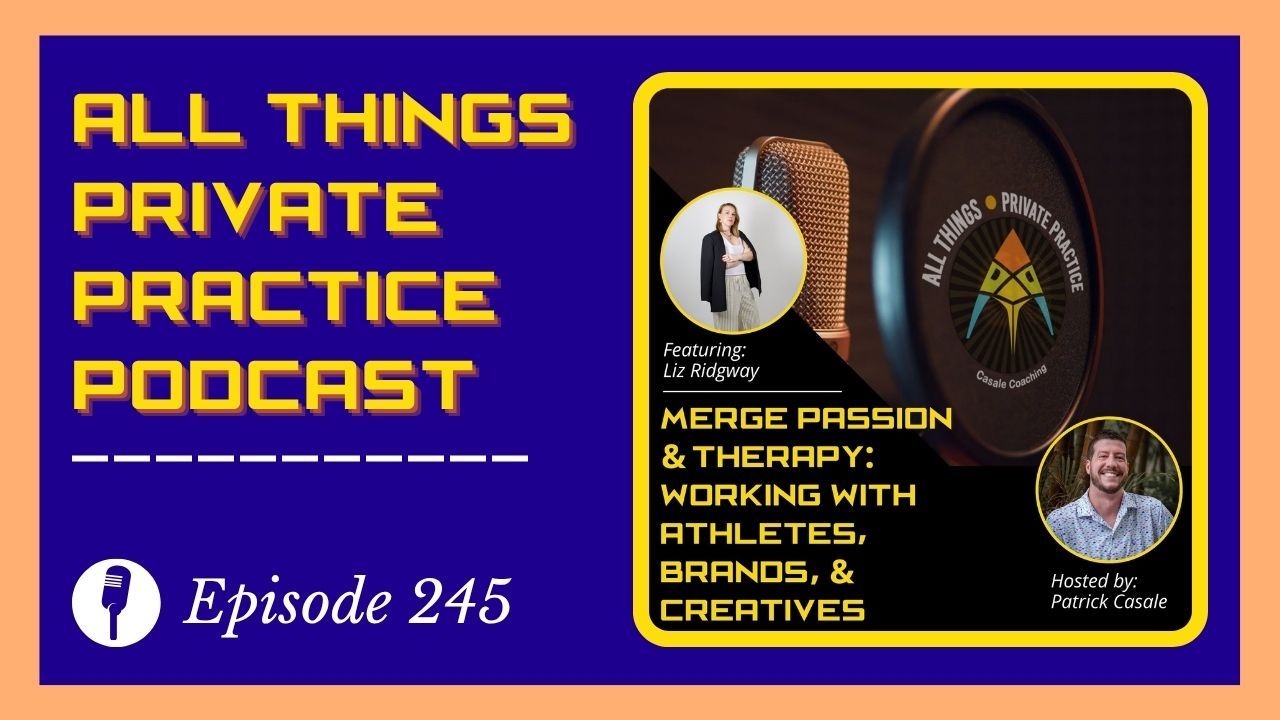
In this episode, Patrick Casale talks with Liz Ridgway about her career journey—how growing up as an athlete in small-town Pennsylvania ultimately led her to founding MENTL.SESH, collaborating with brands like Nike and NASCAR, and supporting high performers and creatives through therapy and consulting.
After years in nonprofit and foster care settings, Liz realized the importance of bringing all passions and parts of herself into work. By building a brand that authentically reflects who she is, she's connected with incredible clients and partners in some of the world’s most high-pressure spaces.
Here are 3 key takeaways:
- Think outside the therapy office: Your skills are valuable across industries. Connect what you love (sports, fashion, music—whatever it is) with your professional expertise.
- Relationship-building is essential: Go beyond just “networking”—form genuine connections with people and organizations in your target industries. Sometimes, years of conversations lead to that dream opportunity.
- Embrace your unique brand: Show up as yourself, both online and off. The clients and opportunities carved out just for you will follow.
More about Liz:
Liz Ridgway, LCSW, is a licensed therapist, speaker, mental health consultant, and content creator specializing in the wellness of elite athletes, high performers, and creatives. Based in Philadelphia and NYC, Liz brings a modern, culturally aware approach to mental health - making her a trusted voice for individuals and organizations looking to prioritize emotional wellbeing in high-pressure spaces.
As the founder of MENTL.SESH, Liz leads a private practice that provides individual therapy and mental health support to athletes, entertainers, entrepreneurs, and creatives. This includes working with MLB and NASCAR athletes and personnel, helping them navigate performance pressure, identity, recovery, and the mental demands of competing on the world’s biggest stages. She also partners with brands and companies to design and deliver interactive workshops, keynotes, and mental health strategy consulting.
Her consulting work includes collaborations with leading global brands such as Meta, Adidas, StockX, Champion, and more - providing training on topics like burnout prevention, identity beyond achievement, and building a culture of mental wellness. Liz is also a sought-after content partner, having worked with Nike, Complex, Bleacher Report, Reebok, Red Bull, Crocs, Disney, The Hundreds, and more. She designed the Nike Air Max 270 React “In My Feels”, the first sneaker to center mental health in both name and narrative.
With a Master’s in Social Work from NYU and a strong digital presence, Liz uses storytelling and social media to break down stigma and build safe spaces where mental health is seen, heard, and supported.
- Website: mentlsesh.com
- Instagram: instagram.com/lizbcroft
- Instagram: instagram.com/mentl.sesh
- TikTok: tiktok.com/lizbcroft
🎙️Listen to more episodes of the All Things Private Practice Podcast here
🎙️Spotify
🎙️Apple
🎙️YouTube Music
▶️ YouTube
✈️ Check out available Retreats
🗨️ Join the free Empowered Escape FB Community
A Thanks to Our Sponsors: The Receptionist for iPad, Alma, & Portland, Maine, Summit 2026!
I want to thank The Receptionist for iPad for sponsoring this episode.
The Receptionist for iPad is a HIPAA-ready digital check-in system that eliminates the need to walk back and forth from your office to the waiting room to see if your next appointment has arrived. Clients or patients can check in for their appointments, and you'll be immediately notified by text, email, or your preferred channel. Break free from interruptions and make the most of your time, because it is valuable. Start a free 14-day trial of the Receptionist for iPad by going to thereceptionist.com/privatepractice. Make sure to start your trial with that link to get your first month free if you decide to sign up.
✨Alma
Thanks to Alma for sponsoring this episode.
Alma empowers you to confidently accept insurance backed by an all-in-one EHR that simplifies scheduling, documentation, and day-to-day practice operations. With a network of engaged providers and free CE courses, Alma makes it easy for you to build the practice of your dreams on your terms. Alma believes that when therapists get the support they need, mental healthcare gets better for everyone. Learn more at helloalma.com/ATPP.
The 2026 Doubt Yourself Do It Anyway Summit is happening for the first time in the United States in beautiful Portland, Maine, on September 1st–3rd, 2026. Portland, Maine, is a beautiful coastal city in the Atlantic Ocean. There's a lot of history there, and it's a very funky, creative, safe, walkable, diverse, and progressive city. You will get 9 NBCC CEs. We have ASWB pending—we'll make an announcement when that's finalized—and have 13 prolific industry leaders. This summit has always been about showing that our skills are applicable in so many different ways, and to motivate you to think bigger, grow in this profession, take more risks, work through self-doubt, and really embrace the doubt-yourself-do-it-anyway mentality. Spots are limited. Reserve your spot here: empoweredescapes.com/portland-maine-summit
Doubt yourself. Do it anyway. See you in Maine.
Free Gifts for Our Listeners
Get a practical podcasting workbook for therapists considering starting a podcast, created by Patrick Casale, host of the podcasts All Things Private Practice and Divergent Conversations.
You'll get a practical structure for therapists who want to start a podcast but don’t want to rush, perform, or build something they can’t sustain.
Grab your free copy: atppod.com/free-podcasting-workbook
✨ Move Beyond Private Practice As A Neurodivergent Entrepreneur
Move Beyond Private Practice As A Neurodivergent Entrepreneur is a FREE 5-part mini-course designed for therapists who want sustainable financial independence beyond one-on-one work.
Access your free mini-course here: atppod.com/move-beyond-private-practice-free
Transcript
PATRICK CASALE: Hey, everyone. Welcome back to the All Things Private Practice podcast. I'm joined today by Liz Ridgway. She is an LCSW, a licensed therapist, speaker, mental health consultant, and content creator, specializing in the wellness of elite athletes, high performers, and creatives. Based in Philadelphia and NYC. This brings a modern, culturally aware approach to mental health, making her a trusted voice for individuals and organizations looking to prioritize emotional well-being in high pressure spaces.
As the founder of MENTL.SESH, Liz leads a private practice that provides individual therapy and mental health support to athletes, entertainers, entrepreneurs, and creatives. This includes working with the MLB and NASCAR athletes and personnel, helping them navigate performance pressure, identity recovery, and the mental demands of competing in the world's biggest stages.
She also partners with brands and companies to design interactive and deliver workshops, keynotes, and mental health strategy consulting. Her consulting work includes collaborations with leading global brands such as Meta, Adidas, StockX, Champion, and more, providing training on topics like burnout prevention, identity beyond achievement, and building a culture of mental wellness. Super cool.
So, also designed the Nike Air Max 270 React in my field, the first sneaker to center mental health in narrative. Did you ever think you would be doing this back when you were in grad school in NYU?
LIZ RIDGWAY: No, no, not at all. I wanted to be in a hospital doing clinical outpatient social work, which is not where I ended up.
PATRICK CASALE: Yeah, you get, like, spit on enough or maybe attacked enough in those spaces, and paid $40,000 a year, and it's no longer an appealing option.
LIZ RIDGWAY: Yep, yep.
PATRICK CASALE: So, what leads you to where you are today, in terms of, like, you know, a lot of people listen to this podcast are more entrepreneurial, so we're thinking outside of the box, moving beyond one-on-one therapy, outside therapy spaces, but a lot of people don't know how to do the things I just listed off.
And you've created some big accomplishments, like working with some huge brands, and athletes, and people who have, you know, a lot of pressure on them, and a lot of eyes on them at all times. And I'm sure a lot of people listening are like, “That sounds amazing that you have gotten to do these things.” So, take us on that journey.
LIZ RIDGWAY: Yeah, absolutely. So, I'm actually from a very small town in Pennsylvania, where most people don't typically leave. You kind of stay. You get married at a young age. And you just kind of continue that cycle.
I wanted just a different path. So, after I graduated from undergrad, I moved to New York City for my master's. I went to NYU. And throughout that journey, I was exposed to a lot of different things. My entire life, I was an athlete. I played basketball, soccer, softball, and in college, I played softball and basketball, so sports have always been a huge part of who I am and how I kind of see the world around me. And I've always been like a diehard Philadelphia sports fan. So, that's kind of rooted in everything I do as well.
But ultimately, after grad school, I started working for a nonprofit, doing FFT therapy and doing in-home therapy, which honestly burnt me out very quickly. It was brutal. And anyone that knows the in-home work, it's an experience.
From there, I moved to a foster care organization doing TF-CBT. And over the course of those about three years, I realized that I loved what I did, but I didn't feel whole. I was kind of living like two separate lives, this girl who, like, loves sports and sneakers. I've been collecting sneakers since I was probably 10. And then, going and doing social work for my career.
And there was never, like, any crossover. And it just felt very weird, because a lot of my friends were in creative industries, and no one kind of understood the nature of the work I did. And it was really hard to just kind of talk with my friends outside of work.
So, along that way, my husband actually works in marketing. And he was like, “You just need an outlet.” So, I started kind of posting on my Instagram back in like 2015, my sneaker collection, and going to sporting events, and just style. Like, genuinely, I don't look like I care now, but I normally love to get a good game day fit off and have so much fun just expressing myself through my style.
And he was like, “You need an outlet.” So, I started posting with my style, my sneaker collection. Never really talked at all about being a therapist or working as a social worker online. And I kind of, you know, talked a lot about this with my therapist at the time. And she's like, “Well, just because other clinicians and other people that are mental health professionals online aren't posting about that doesn't mean you can't.”
So, it kind of changed my perspective a lot, because I kind of felt like if I needed to show up as a therapist online, I had to fit into a box, I had to have the kind of very similar aesthetic, I had to post about the same types of things. And I didn't want to do that, because I just felt like there was no separation between my life and work.
So, I started kind of connecting the dots between sneakers, and style, and mental health, just for fun. And it grew my following and led me to have some really cool opportunities.
Fast forward to 20, I think, 19, I had Nike reached out. We worked on a seeker together for mental health awareness, and it was kind of a full-circle moment, which then, eventually, led to a lot of other partnerships.
And that's eventually kind of what led me into realizing that you can bring more of who you are into this work. You can think outside the box. And it's okay that not everyone's going to understand or agree with it, but it feels more fulfilling to do that. So, led me to different product collaborations, consulting, and then, eventually, launching MENTL.SESH, which is my private practice, where I work with primarily high performers, athletes, and creatives. And have kind of been able to bring it full circle through, you know, owning who I am and not really giving a shit about what other people thought.
PATRICK CASALE: Yeah, yeah. Well, Said, that's a cool little snapshot, too. And I think a lot of people get caught up in that mentality of like, grad school has told me I have to be a certain way. All the colleagues that maybe I surround myself with say the same things. And you really do start to believe it, of like, there's only one way to be a therapist. There's only one way to show up. I've got to wear, like, cardigans. And I've got to, like, repost the same trauma graphics that everyone else is posting.
And in reality, like, how often is that relatable? How often does that land for everybody who's looking for support? And the answer is like hardly ever. And it just feels like very generic, very recycled. And I think it's often times, because so many of us have had zero conversation about marketing, about branding, about business ownership, because I think our profession does us a disservice by almost, like, trying to push you away from business ownership. And they're like, “No, that's not for you.” Or, “You don't get into this to make any money at all. It's just self-sacrifice.” And it's just a recipe for constant burnout and exhaustion.
LIZ RIDGWAY: Yeah, 100%. And it's, you know, trying to just fit into a mold that if that's not who you are, it eventually also creates resentment toward your career because you're just like, “I'm showing up. I'm not looking forward to this. I don't like this kind of code switching or this mask I have to wear in order to fit in.”
And I think for me, a lot of it too, was, you know, there's a big generational difference where, at the time, like I felt like a lot of people making decisions, or people that I wanted to earn respect from were people who just didn't use social media in that way, because generationally, they didn't grow up with social media in the same way that I did.
And I think, like, trying to be accepted by them, but also trying to then, you know, attract the type of client that I want to work with in private practice is they're two different people. And I had to come to accept that if people are going to look at me just based on my social media, that kind of is the opposite of what our profession really, you know, like, promotes, and as well as I'm out here trying to help my clients show up as the best version of themselves. And if I don't do that, like, who am I to be, you know, telling these people, like, how to help them and live their lives in that way. So, it just kind of felt a little hypocritical to me.
PATRICK CASALE: Yeah, that's well said. And I think, you know, in 2026 we have this, like, era and culture of social media therapists and therapists who are building brand recognition and visibility outside of the therapy space.
I mean, I think about a colleague and friend, Jeff Gunther, who's got millions of followers in social media and is beloved or potentially hated in a lot of those spaces. And he's been on this podcast several times. And I just think about some of the things he was talking to me about in some of those episodes, and just the realization of there's so much more outside of the traditional therapy space, and we have skills that are applicable in all areas of life, and we just often don't know how to apply them. We can talk very confidently about, like, how to do treatment interventions and how to navigate crisis response, but in reality, like, how often are we thinking about how our skill sets, and our education, and our lived experience also helps create a more holistic picture of what we can offer society. And that can be very individualized, as you're sitting here saying, like, I've worked with NASCAR, and Nike, and was it the MLB?
LIZ RIDGWAY: Mm-hmm (affirmative).
PATRICK CASALE: And the MLB. And just like, how many therapists get to say that? I don't really think that many people get to say those are a part of my experiences and my career path. And that's really, really cool.
LIZ RIDGWAY: Yeah. And I think a lot of it is honestly like, who I am. I love NASCAR, I love baseball. I'm a diehard Phillies fan. And it's ironic because some of the teams that I, you know, work with as a therapist are, you know, technically rivals, but it's being able to kind of shift that, you know, mentality when you're working with your clients and not wanting to sabotage everything, you know? But at the same time, it's cool, because it's something I genuinely love as a human, and it helps me show up even better clinically when I do have to show up that way.
PATRICK CASALE: Yeah, it feels much more aligned. So, you can be more authentically you, which is going to create more passion, right? Behind whatever you're marketing or trying to obtain. And it's going to kind of create that orbit.
So, I want to ask you a bunch of sports questions, but we can save that for a different time, although I would love to know who you think the Eagles should hire as an offensive coordinator.
LIZ RIDGWAY: Brutal.
PATRICK CASALE: Brutal is real, yeah, very, very real. So, I think that a lot of people listening are probably like, wow, this sounds amazing. How the hell do I start any of this? Like, if I wanted to pursue a career with maybe attracting different types of clients, maybe pitching myself in situations where I feel uncomfortable or unqualified, what would be your advice in that scenario?
LIZ RIDGWAY: Yeah, I think for one, you know, what I would suggest is really sit down and kind of write down a list. And I'm big on writing things down, making a vision board, doing things like that, because it also just kind of helps you, you know, have a direction as far as what goals you want to go toward.
But write a vision, write down a list, a vision board, of the brands, the type of clients that you want to work with, that you want to attract, because also, then, you have a list of, hey, these are the people that I can now go on LinkedIn, find the marketing people, find the people I need to connect with. Ask those people to get coffee.
What I would recommend is form human connections with people at these companies. Don't just blindly reach out and say, “Hey, I'm so and so. And here's my media kit. And I want to work together.” It is really relational.
A lot of that work for me was, at the time when I lived in New York City, I was going to events constantly, and like, yes, I was getting invited to a lot of like, Fashion Week events and a lot of events that weren't clinical at all. But it helped me create a network that is so vast that has nothing to do with therapy and mental health.
A lot of my connections are sports agents. They're people in the marketing departments of different brands, from PR agencies, from marketing agencies. They're all the people that are going to hire me to do the jobs that I get to do. But a lot of it was putting myself out there in a world that, like, I can't relate to a lot of people, because I can't go and talk about work and have this conversational works, you know, Fashion Week's tough. It's just different. But learning about what they do, and finding the common ground between the two of us, and then eventually saying, like, “Hey, I would really like to figure out a way we can work together. And this is what I do when it comes to mental health.”
And you know, you see a lot of brands today, especially after 2020 and COVID, wanting to have these conversations online about mental health.
So, for a lot of it is forming the relationships, genuinely asking people for coffee, Zoom calls, whatever you can, just to form a human connection. Two, create a media kit for yourself. Now, that can look a lot of different ways, depending on what you want to do, but usually, like mine right now, has to do a lot with my engagement on social as well as it shows speaking engagements. Like, whatever you want to do.
So, if you want to do content partnerships, you're going to need your social analytics. If you want to do speaking engagements, you're going to probably want links to other opportunities that you've done in the past to kind of showcase your work. You want to have, like, this media kit, essentially, as your resume of the things you've done outside of the clinical realm. If you want to do consulting, what you've done in the past for consulting? And have a nice, designed, clean, kind of media kit that you can share.
And then, lastly, I would say is, you know, really try to, when you pitch to brands, bring them the idea. Like, a lot of the times that I'm pitching to brands, like, if they have the budgets, and you're saying, “Hey, I see you have this product that you're about to release.” Or, “If you are thinking of including mental health or wellness in your, you know, content or any campaigns later this year, here's how I can get involved and kind of help, one, from a liability standpoint. Two, from an expertise that I can I can provide and give you. And three…” You know, sometimes I'll do like, kind of creative collaboration or creative consulting with them.
So, like, for example, I've worked with brands in the past who are putting out sneakers, and I worked during the design phase of their… The sneakers were for mental health. But how can we make this shoe an actual tool? So, whether it like included sensory materials or different phrases, or, you know, incorporations on the shoe that would help someone's mental health. So, things like that.
But I think if you bring them the idea, and it fits with their goals, and you also would understand those goals based on having those conversations from those relationships you're building, you can then, most of the time, though, if they have the budget. So, like, all right, let's try it out. Let's, you know, figure out how this works.
PATRICK CASALE: I love that. Yeah, so relationship building is foundational, right? And I think what you said is really important is that a lot of therapists only surround themselves with other therapists. You mentioned, kind of creating this, like, vast network, because you are around a lot of different types of people in that experience in New York City.
And I think that's really, really important. And I see that happen way too often, is where, like, therapists surrounds themselves with therapists who only thinks about these things as a therapist, doesn't think about them in any other sense, of, like, marketing, branding, business ownership, relationship building. And then, is convinced there is only one way to do this work, or there's only one way to accomplish this goal. So, having those different perspectives is freaking huge.
And I like what you said. Like, if you can't go out to meet people for coffee in person, invite them to a virtual coffee meet and greet, or just, like, a call, just to get a sense of who they are, because otherwise you're just like, almost like, cold calling and just blasting the same message out into the internet without a lot of response. It's always going to work a lot better if it's personable, if there's relationship behind it.
And then, like you said, building that brand kit. And if you're like, “I don't know how to do that right now, that feels impossible, Canva is really easy to use. And there are lots of strategies and tools out there, and ways that you can do that on your own, at first. It doesn't have to be perfect, like you can fine-tune it, you can edit it, you can improve it, but at least taking the steps to get these things started, so that then you can feel a little bit more confident when you maybe develop these relationships and start to put this stuff in front of people.
LIZ RIDGWAY: Yeah, I think too, just having, like, realistic expectations. Like, sometimes these partnerships don't happen immediately. Like it is a year or two years of investing your, you know, energy into these relationships to really see a turnaround on that. Like, I go to NBA All-Star Weekend typically every year for, you know, in the past, it was for clients, and now it's a mix of clients and for brand partnerships. And, you know, different work opportunities.
And there's been people that I've had coffees and lunches with that, like, now, three years later, I have potentially a full or a part-time position for their apps that they're working on, or different things, which is really cool, but, like, it didn't happen immediately, and that's okay. I think that's just figuring out, like, people will keep you in mind. It's just you got to just stay consistent.
PATRICK CASALE: I love that. Yeah, I think that's really important. I mean, super cool that you're doing all this stuff. I mean, it's inspiring for me, for sure. And I think for a lot of the people listening, because I'm sure a lot of you want to do more of this creative work, and to push your brand, and leverage, and build relationships, and get more visibility on the projects and things that you want to do.
And I think it's a two-way street too, so not going into those relationships just solely seeking out, like, how can I work with this person or this company, but really making sure that you can bring your expertise, your personality, your lived experience, your thoughts and feelings about certain topics into these conversations. And that goes back to just being able to be yourself. And I think that's really a huge, important part of this conversation.
LIZ RIDGWAY: Yeah, 100%. Just owning who you are. And, you know, people now, I guess, have more of a understanding, but I'm not a therapist who's going to show up in a suit. I don't even think I own a suit or anything, cardigans, no throw them out. But I will have a fire pair of sneakers on, that is guaranteed.
And so, you know, that is kind of the thing is like, you know, this is who I am. And kind of thinking of myself as a brand, right? Like, when I'm with my friends, I'm me, but like when I'm in any of those settings, like how I conduct myself, how I dress. Like, a lot of those things go into the branding of myself and MENTL.SESH, which, you know, is part of it. I think there's so many angles to forming your brand, and what makes your brand unique or stand out that we don't think of. It's not just like your website and your email signature. It's, you know, the curation of your social media. It's the brands that you choose to wear, or not choose to wear, if you're someone that is into fashion. It's the people you associate yourself with, unfortunately. There's a lot of things that I think go into it that, you know, do play a role?
PATRICK CASALE: Yeah, yeah. That's really well said. That's really well said. Well, I appreciate you coming on here. I have a hot seat question for you that you may or may not want to answer. At the end of next season is Nick Sirianni, the coach of the Philadelphia Eagles.
LIZ RIDGWAY: I truly think it depends if A. J. Brown is on the team next season or not. I think A. J. is going to be back, but I don't know, because we are running through offensive coordinators at this point, so I don't think he's got to go far next season to even make that happen?
PATRICK CASALE: Yeah.
LIZ RIDGWAY: Yeah.
PATRICK CASALE: I saw a stat the other day that Jalen Hurts has not had the same offensive coordinator since his sophomore year in Alabama. That is fucking wild.
LIZ RIDGWAY: Yeah.
PATRICK CASALE: I think about that all the time, like the transition and change. Anyway, great answer, good therapist answer, by the way. As a Bills fan, I'd love to have A. J. Brown on the team, so we'd love to be thrown to someone other than Khalil Shakir and 300-year-old Brandin ooks. But anyway…
LIZ RIDGWAY: I respect Bills Mafia so much. I have a couple friends that are Bills’ fans. And honestly, like that is a tailgate I need to go to. I need to get to a Bill's tailgate. That's on my bucket list.
PATRICK CASALE: You're not that far from Buffalo. I think that's attainable. You can watch people get suplex through folding tables. I mean, they travel well, they show up well, and they support a lot of the community. So, a lot of respect out there for that.
Anything you want to share with the audience about how they can find you, connect with you, work with you, any of those things.
LIZ RIDGWAY: Yeah. I mean, my Instagram account is @lizbcroft. My maiden name is Beecroft, B-E-E-C-R-O-F-T. But L. Beecroft was not available, so it's @lizbcroft.
And then, MENTL.SESH is my private practice account. Same www.mentlsesh.com my website. And yeah, we're working on some fun things for the year, and have a lot of different partnerships coming up with NASCAR that I'm really excited about. So, I guess stay tuned for some of that stuff.
PATRICK CASALE: Cool. Yeah, that's exciting. And congrats on all the success and continued success. We will have all of that information in the show notes, so you have easy access to everything Liz just mentioned. Appreciate you coming on and making the time today.
LIZ RIDGWAY: Of course. Thank you so much for having me.
PATRICK CASALE: You're welcome. And to everyone listening to All Things Private Practice, new episodes are out on Saturdays and all major platforms and YouTube. Like, download, subscribe, share. Doubt yourself, do it anyway. See you next week.
FREE PRIVATE PRACTICE GUIDE
Join the weekly newsletter for private practice tips, podcast updates, special offers, & your free private practice startup guide!
We will not spam you or share your information. You can unsubscribe at any time.






![Episode 247: Therapy for Religious Trauma and Spiritual Abuse [featuring Michelle Moseley]](https://kajabi-storefronts-production.kajabi-cdn.com/kajabi-storefronts-production/file-uploads/sites/2147507511/images/2fcde71-1a24-73ef-244-52bcff6212f_ALL_THINGS_PRIVATE_PRACTICE_PODCAST_Episode_247.jpg)
![Episode 246: Neuroinclusive Workspaces That Truly Support All Neurotypes [featuring Pasha Marlowe]](https://kajabi-storefronts-production.kajabi-cdn.com/kajabi-storefronts-production/file-uploads/sites/2147507511/images/334bf3d-e7c-8667-e815-e640c1babe_ALL_THINGS_PRIVATE_PRACTICE_PODCAST_Episode_246.jpg)
![Episode 244: Marketing: For Therapists Who Hate Marketing [featuring Carrie Wiita]](https://kajabi-storefronts-production.kajabi-cdn.com/kajabi-storefronts-production/file-uploads/sites/2147507511/images/068ba14-13c7-236e-e53b-bd3735f5ac73_ALL_THINGS_PRIVATE_PRACTICE_PODCAST_Episode_244.jpg)