

Show Notes
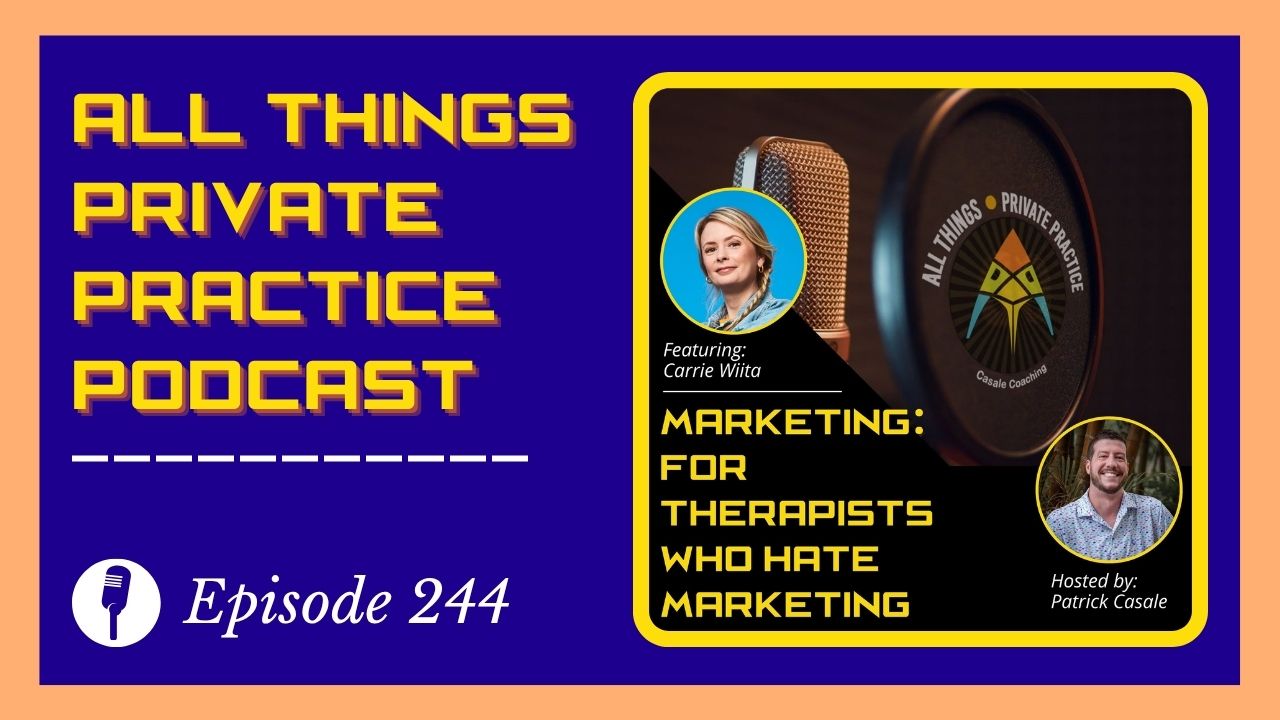
In this episode, Patrick Casale talks with Carrie Wiita, M.S., an adjunct professor, consultant, former actor, and creator of Interpersonal Branding. Carrie offers eye-opening insights into what makes marketing for therapists truly authentic—without the cringe and echo chambers.
Here are 3 key takeaways:
- Niching Down Is Not Everything: The advice to "niche down" is only one marketing strategy. It works for some, but it’s not the end-all-be-all for sustainable success. Therapists can also thrive through a differentiation strategy—by standing out based on who they are as people and clinicians.
- Therapists Face Unique Marketing Challenges: Unlike other industries, therapists have serious limitations—like licensing, scope, and the nature of their audience. Traditional marketing advice often doesn’t fit. “Trickle down marketing” was not designed for therapists, and there is a need for strategies that truly reflect the unique realities of private practice.
- Define Your Interpersonal Brand: Before worrying about reaching your "ideal client," get clear on your own public professional identity—what you stand for, how you work, and what values guide you. Authenticity and alignment with your own style are just as critical as your niche.
It’s time to rethink the rules and put yourself—your real self—at the center of your brand.
More about Carrie:
Carrie Wiita, M.S., is an adjunct professor, consultant, former professional actor, and creator of Interpersonal Branding, the first marketing and professional identity development framework for therapists and other service-providers. She hates trickle-down marketing that makes therapists feel cringey about putting themselves out there and is rabidly obsessed with helping therapists improve clinical outcomes and craft a sustainable career using Interpersonal Branding.
- Website: interpersonalbranding.com
- TikTok: tiktok.com/@theinterpersonalbrand
- Instagram: instagram.com/theinterpersonalbrand
- Facebook: facebook.com/theinterpersonalbrand
- YouTube: youtube.com/@theinterpersonalbrand
- LinkedIn: linkedin.com/in/theinterpersonalbrand
🎙️Listen to more episodes of the All Things Private Practice Podcast here
🎙️Spotify
🎙️Apple
🎙️YouTube Music
▶️ YouTube
✈️ Check out available Retreats
🗨️ Join the free Empowered Escape FB Community
A Thanks to Our Sponsors: The Receptionist for iPad, Alma, & Portland, Maine, Summit 2026!
I want to thank The Receptionist for iPad for sponsoring this episode.
The Receptionist for iPad is a HIPAA-ready digital check-in system that eliminates the need to walk back and forth from your office to the waiting room to see if your next appointment has arrived. Clients or patients can check in for their appointments, and you'll be immediately notified by text, email, or your preferred channel. Break free from interruptions and make the most of your time, because it is valuable. Start a free 14-day trial of the Receptionist for iPad by going to thereceptionist.com/privatepractice. Make sure to start your trial with that link to get your first month free if you decide to sign up.
✨Alma
Thanks to Alma for sponsoring this episode.
Alma empowers you to confidently accept insurance backed by an all-in-one EHR that simplifies scheduling, documentation, and day-to-day practice operations. With a network of engaged providers and free CE courses, Alma makes it easy for you to build the practice of your dreams on your terms. Alma believes that when therapists get the support they need, mental healthcare gets better for everyone. Learn more at helloalma.com/ATPP.
The 2026 Doubt Yourself Do It Anyway Summit is happening for the first time in the United States in beautiful Portland, Maine, on September 1st–3rd, 2026. Portland, Maine, is a beautiful coastal city in the Atlantic Ocean. There's a lot of history there, and it's a very funky, creative, safe, walkable, diverse, and progressive city. You will get 9 NBCC CEs. We have ASWB pending—we'll make an announcement when that's finalized—and have 13 prolific industry leaders. This summit has always been about showing that our skills are applicable in so many different ways, and to motivate you to think bigger, grow in this profession, take more risks, work through self-doubt, and really embrace the doubt-yourself-do-it-anyway mentality. Spots are limited. Reserve your spot here: empoweredescapes.com/portland-maine-summit
Doubt yourself. Do it anyway. See you in Maine.
Free Gifts for Our Listeners
Get a practical podcasting workbook for therapists considering starting a podcast, created by Patrick Casale, host of the podcasts All Things Private Practice and Divergent Conversations.
You'll get a practical structure for therapists who want to start a podcast but don’t want to rush, perform, or build something they can’t sustain.
Grab your free copy: atppod.com/free-podcasting-workbook
✨ Move Beyond Private Practice As A Neurodivergent Entrepreneur
Move Beyond Private Practice As A Neurodivergent Entrepreneur is a FREE 5-part mini-course designed for therapists who want sustainable financial independence beyond one-on-one work.
Access your free mini-course here: atppod.com/move-beyond-private-practice-free
Transcript
PATRICK CASALE: Hey, everyone. Welcome back to the All Things Private Practice podcast. I'm joined today by Carrie Wiita. And she is an adjunct professor, consultant, former professional actor. I didn't know this about you.
CARRIE WIITA: Really.
PATRICK CASALE: Creator of interpersonal branding, the first marketing and professional identity development framework for therapists and other service providers. She hates trickle-down marketing that makes therapists feel cringy about putting themselves out there, and is rabidly obsessed with helping therapists improve clinical outcomes and craft a sustainable career using interpersonal branding.
Welcome back to the show. Last time I saw you, it was when you were doing the very bad therapy podcast. Is that what it was called? I can't remember.
CARRIE WIITA: Yeah, yeah, very bad therapy.
PATRICK CASALE: Almost three years ago.
CARRIE WIITA: Yeah.
PATRICK CASALE: And it's good to see your face again. And I remember really enjoying our conversation back in the day, and you were in grad school at the time, kind of working through your program. And tell them real quick [CROSSTALK 00:02:23]. Can you share a little bit about that? I did not know this.
CARRIE WIITA: Really? Yeah, it's funny. It's so central to my life and my identity. I think that I feel like everybody must obviously know this, but I forget that they don't.
PATRICK CASALE: True.
CARRIE WIITA: Yeah, it was my driving ambition for my whole life. I started acting professionally, like in Oregon, when I was a little kid. And when I got out of college, I went to UCLA, studied English, not theater, and then when I graduated, I hustled to become an actor. And so, eventually, it started working. And so, I had a career as a working actor for about 15 years in Los Angeles, and so you don't know me from anything. And the only thing that people know me from, if they know me from anything, is, well, if you're a super, like, old school fan of the show Reno 911-
PATRICK CASALE: I actually was, yeah.
CARRIE WIITA: I had a few appearances on Reno.
PATRICK CASALE: Wait, what?
CARRIE WIITA: Oh yeah, yeah. I was an underage student that Ben Grant attempted to pick up before finding out I was like 11 or something. I was a truck stop hooker. I was a slutty cheerleader, slutty principal. I did a lot of comedy sluts in my time. That was my bread and butter.
Yeah, and then I think the thing that most recently people know me from is, it didn't come out this year, but every Halloween for the past few years, most every year there's a GEICO commercial with a haunted house and a group of teens trying to escape a serial killer. And one of the teens encouraged says, why can't we just get in the running car? And that is yours truly.
PATRICK CASALE: Wow, I didn't know I was with royalty right now.
CARRIE WIITA: Yeah, that's generous. I appreciate that very much. In LA, it is just a job. It is another job that you got to keep hustling to keep that health insurance. And eventually you realize it's not a good fit anymore. Hence, the pivot to psychotherapy. And that's, yeah, how I found my way to grad school.
PATRICK CASALE: Which is actually like a very good transition point for what we're going to talk about today, because you want to talk about marketing, and interpersonal branding, and niching, and not being cringy when marketing. And I think like figuring out who you are along the way in this journey as a small business owner is all a part of that.
And I think that so often our target audiences are versions of ourselves. I think we get into this field for a reason. And I think that we really fucking suck at the business side of things and really, really struggle with how to show up in an authentic way that feels aligned to us, that feels natural, that feels comfortable, that doesn't feel gross.
I always used to put people on the spot my coaching programs and ask, like, what's the holdup with marketing? And everyone would say, like, “I feel like a used car salesperson.” That was always the line, something like that.
CARRIE WIITA: Yeah, oh my gosh. Spot on. Absolutely. That was the thing that struck me the most about this field, coming into it, pivoting from a different field, and I had a sales and marketing background back in the day. I've had jobs in nonprofits and for-profit, education, marketing, Starbucks, you know, like all the things. I've done all the weird things. And as an actor, like, that is the job is marketing yourself. That's way more of the job than it is the craft of acting.
PATRICK CASALE Sure, sure, yeah.
CARRIE WIITA: And so, yeah, that was my comfort zone. Like, I understood marketing as, like, that's the thing you got to do as an adult. Once you start adulting, you have to market yourself in this world to make a living.
And then, I came to grad school, psychotherapy grad school. My program was a marriage and family therapy program here in LA at Cal State, Northridge. But I think all programs are more or less the same.
I instantly got this sense about this hatred of marketing, this real stigma around marketing in the field.
PATRICK CASALE: Yep.
CARRIE WIITA: And another lecture for another time is one of the things that I kind of learned in the process of all this research that I've been doing is that I think that our field gets delivered upon our entry into the field, we get delivered a message that good therapists don't talk about themselves in public.
And that is a cultural message. It's a historical message. It gets compounded by a lot of the kind of peer-to-peer sort of policing that happens in our field. And it's very thorny. And once you're in grad school, you know, you kind of hear this, and you're like, “Oh, okay, great. Like, I would never, I would never do that.” And you build your identity, your professional identity around, I'm not like that. I would never do that. And that's what the field secretly wants from you as a therapist.
And so, I was curious about that, because I've been listening to, you know, more entrepreneurial therapists, their podcasts, Kurt and Katie on the Modern Therapist Survival Guide podcast, Ben Caldwell, who's got a billion different entrepreneurs. Those are the people that I became, like, early on introduced to. And I was like, “Wait a minute. That seems to run really counter to this, what is going on with marketing in therapy?”
And so, I actually did my master's thesis on the intersection of marketing and psychotherapy, and that's from there. It was like a 250-page multi-disciplinary literature review, because like I set out to study, like, how does our field like, what's the best way to market to psychotherapy clients? What's the best way for psychotherapists to market themselves. What does our field have to say about that? Turns out, no literature on them. Very little, very little literature.
PATRICK CASALE: All anecdotal, all anecdotal.
CARRIE WIITA: If so, like if it's even published, it's all just what we get. What is available to us is what gets sold to us after we graduate.
PATRICK CASALE: Right.
CARRIE WIITA: And that's what we're left with. And that's what I call trickle-down marketing is marketing that has come to us from other fields that was never intended for our field, because our field has invested nothing in finding out what is right for therapists. And so, we got to take what we can get. We take the scraps.
PATRICK CASALE: We take the scraps.
CARRIE WIITA: We do, literally.
PATRICK CASALE: We take the scraps. More often than not, you see it probably all the time of like, people just put it out into a big therapist Facebook group, and then you get responses that are all kind of similar. And it's like, of course, we're like, rinse, and repeating, and regurgitating the same information, if all we've ever been told is the same information. So, you're asking people for advice who have gotten their advice the same exact way, who don't actually know what they're offering, but they've been told by one or two old, crotchety therapists that this is what you do. And then, they say it, and then they believe it, and they also set their rates that way.
CARRIE WIITA: Oh, my God, 100%. You cannot be more right. And it's infuriating. And I think that what happens, how therapists fall into this, is because I do think in our field, we get kind of indoctrinated with what I call the tyranny of doing it right. And like we get threatened from day one of grad school, right? That, like, you're going to lose your license, you're going to irreparably harm your clients, you'll be laughed out of the field if you do anything wrong. So, do it right?
PATRICK CASALE: Yeah.
CARRIE WIITA: And so, you know, a lot of therapists didn't get into this field wanting to run a small business.
PATRICK CASALE: Sure.
CARRIE WIITA: And then, suddenly, they realize that's what they're being tasked with on the other side of grad school.
PATRICK CASALE: Yes.
CARRIE WIITA: And it's like, the field has nothing to offer them, he vacuum is filled with marketing advice that works great in other contexts, but has serious limitations in our field. But then, you're right, we hit this echo chamber, this same advice gets bounced around back and forth, and then therapists are assuming, “Oh, this is what marketing is because I heard about it in this Facebook group. I heard it about it on all the podcasts. I heard about it every…” And this is what marketing is. And then you do, you see this like echo chamber of therapists asking other therapists if their marketing is any good.
And those therapists who are being asked are responding based on what they learned from the marketing gurus who told them, “This is how you do it.” And it just crescendos. It just goes and goes. And that's where I feel to, you know, to bring us back to our conversation before we jumped on the air like, what I think is the biggest, like, tragedy of this echo chamber is this conflation of this idea of niching down with marketing in total.
PATRICK CASALE: Right. As if that's the end-all be-all.
CARRIE WIITA: It's such a misconception there is. Like, you hear this drum beaten a lot, like, niche now, niche now, niche down. And can be great advice. Happy to talk about how it is great advice. It can be, but it is one strategy, it is one strategy for marketing.
PATRICK CASALE: Yeah, it's one, like, very small sliver of the pie, right? And it's ultimately the same when I see people solely reliant on, like, their Psych Today profiles, and then, there's the anecdotal advice that gets thrown around in the Facebook groups of like, “I've updated to keep up with their algorithm and to change my profile like by a word or two so that I'll get bumped up the feed.” And it's like there's no evidence that that is true. Maybe that has happened at times when you exist in a small community with seven other therapists, but ultimately, there is no evidence that updating your profile or putting an extra comma in to trick the algorithm is going to boost you to the top.
But that is what I see all the time. And it just makes me want to smash my computer. And just like I've given up on offering feedback and support in that instance, because there's no point in a lot of ways. But ultimately, you see that. You see the niche component.
And I stress a lot of the times, like, narrow down your niche, figure out who you're marketing to, but it's more about like, if you're going to solidify, and specialize, and really own it and say, this is who my ideal target audience is, it doesn't end there. You have to figure out the steps to actually get in front of those clients. And it is a hell of a lot more than just saying, like, I specialize in supporting high-achieving, neurodivergent entrepreneurs who will never think that anything they do is good enough. And, you know, blah, blah, blah, blah, blah.
CARRIE WIITA: Yeah, no, you're totally right. Niching down is a positioning strategy. And it's a tried and true one. It's a strategy that comes to us from, you know, the e-commerce, online marketing, side hustle world. It really hit its stride, I think, in the mid-2010s. And like, it's kind of sister concept, personal branding, right? Which some therapists have heard that concept, you know it if you haven't heard that phrase. But it's a strategy that was originally designed for product marketing and became applied to people, which worked, and, you know, it works, I think, very well in other aspects, in other fields, in other industries and contexts.
In therapy land, I think it seemed like it was kind of like, it hit perfectly, right? Because first of all, there's this total vacuum of advice designed for us and our clients, but also, we just naturally, by virtue of the service we offer, we naturally like slice and dice our consumer base by population and by diagnosis, right?
And so, it seems like when you first learn what niching down means, like, “Oh, my God, yes, that makes sense.: But what it really is, is like it's, yeah, some people have a real problem with it, and this is where the conflation happens, is this idea that just by doing that, by identifying your target, this, like, super niche population, that that is marketing.
And you said it earlier, like, then you have to go find them. And that's where strategy and techniques come in. So, my thing these days is no niche, no problem. That's fine. It's fine if you don't have a niche. Because I do think for some therapists, it works great, particularly if you do have an area of expertise, a specialty that does suit this population diagnosis, like segmentation, very, very well.
But the thing I want to, like, point out is that this niching strategy comes from a very different context. It comes from a business context where they do not face the limitations that therapists do in their private practice.
I have to start by, start by explaining very quickly, in a very tiny nutshell, this business concept, it's a business school term called TAM, SAM, SOM. TAM is your total addressable market. SAM is your serviceable addressable market. And SOM is your serviceable obtainable market, all right? And it's easy to understand your total addressable market is the total universe of anybody could ever buy your stuff. Your serviceable addressable market is like your reachable audience, okay? This is people you could realize realistically reach, given whatever you're selling, the features, where you're selling it, the location, and your target audience, right? And then, the SOM is the realistic share. The people that you could the consumers or customers you could realistically capture.
This, like, idea of niching down when applied to, like, a side hustle environment, an online marketing world, right? Or e-commerce products, right? In e-commerce setting, your TAM, the total universe of anybody who could buy. It's everyone with an internet connection and a credit card, right? That's who your total addressable market is.
If you're selling hiking shoes, say, for example, then your serviceable addressable market is anyone with an internet connection, anyone with a credit card, and a need for hiking shoes, right?
PATRICK CASALE: Right.
CARRIE WIITA: Okay, so now we're narrowing it down, because you are narrowing who you're selling to based on what you're selling. And then, your SOM is the realistic share? Realistically, who you're selling to is people with an internet connection, a credit card, a need for hiking shoes, and whatever it is about your hiking shoes that suits them, right? Whether they like the brand? Do you make it in the right sizes that fit their feet? Is the price point amenable to them? All that.
Therapists, so before I move on to therapists, niching down in this context is super helpful, because your total addressable market is anybody on the planet with an internet connection and a credit card.
PATRICK CASALE: Right.
CARRIE WIITA: And even once you get down to your serviceable, achievable market, your SOM, your obtainable market, SOM, you're still talking about quite a lot of people, anyone with an internet connection, a credit card, a need for hiking shoes, and they like your shoes. That's where niching becomes helpful. That's where niching can be super powerful because now you're like a new balance versus a hawker or whatever, you know?
With therapists, the problem starts because our total addressable market, like the universe that's available to us, is first and foremost, limited by your license.
PATRICK CASALE: Right.
CARRIE WIITA: Right. So, in the US, that means, if you're licensed in one state, that's your total addressable market, that's who you start with.
PATRICK CASALE: Right.
CARRIE WIITA: And then, so like, say you are like a therapist who's licensed in Oregon, okay, the first group you have to start with is people who live in Oregon. But then, you're also, to a certain extent, limited by your scope of practice and competence, right? Which is not necessarily true for other professions.
If you are not by training or by your license competent to treat couples, families, or children, then you're also limited to adults who live in Oregon, adults only who live in Oregon.
PATRICK CASALE: Yep.
CARRIE WIITA: If you feel like certain diagnoses are out of your of competence, like schizophrenia or a lot of therapists don't feel comfortable treating borderline personality disorder, then you are also limited by diagnosis. Okay, so we've already, to begin with, narrowed the market so much. Then remember, you have to like narrow that down to the addressable market, right? The people that you could actually conceivably use your services. Say you have an office in Portland, Oregon, okay? And maybe you also do telehealth. So, then your addressable market are adults without these specific diagnoses who can access your office in downtown Portland, whatever that… Like, drive to a walkway, whatever it is.
And also, anyone who is able to do telehealth in the state of Oregon. But again, that is who thinks to therapy can is fine, is worth paying for over telehealth. They don't think it's only an in-person service, people who have an internet connection. I'm from Oregon originally. I know that internet is not always in the entire state of Oregon, good enough to go do a therapy session. Okay, so we've already limited that. Now, we're talking about the clients you can actually reach.
We've narrowed it down to already a very specific group of people, and now we're talking about, who can you get in front of? Who thinks therapy is going to help them with their problem? You know? Who's looking for a therapist right now? They might already be in therapy with a therapist, so they're not even in the market right now. And some of them are trying other things other than therapy for the same thing you want them to try therapy for, right?
So, this is where I start to see a lot of therapists get really demoralized once they try “niching down” and then it doesn't work. And I often want to say, the thing is, you can I think a niching down strategy is great if that suits who you are as a clinician and it suits your business, but it doesn't always for everyone, and there are other options.
The alternative that I really see for niching down, for most therapists, is what is called in the marketing literature differentiation strategy. And I describe this basically as, you know, your niche is people who want to work with you, right?
I often cite therapists like Lori Gottlieb or Brené Brown in this category. Like, these are therapists that almost any consumer would jump at a chance to have a therapy session with, not because they fit the niche, not because they're… Brené Brown doesn't have a target audience.
PATRICK CASALE: Right.
CARRIE WIITA: You know, like but she developed this reputation and a brand, truly a brand, that is so strong, that almost anyone could figure out, like, how they work with her. Now, some people hate Brené Brown, but that's, honestly, what I think is, is great. Patrick's raising his hand, and, you know-
PATRICK CASALE: Hate is a strong word, but, you know, not a fan.
CARRIE WIITA: You're a wrong-fit client for Brene Brown, which is great. I think strong marketing does that. Strong marketing, in my opinion, should do two things in equal measure, and that's inspire approach behavior and right-fit clients, and, in equal measure, avoid behavior in wrong fit clients.
PATRICK CASALE: Right. Yeah. We talk a lot about attract and repel on here, and-
CARRIE WIITA: Yeah.
PATRICK CASALE: A big part of it, of like, attract the people who are right for you, repel the people who are not a good fit for whatever reason.
CARRIE WIITA: Yeah, because, don't you think therapists get caught up sometimes in being afraid of turning people off?
PATRICK CASALE: 100%, and they get afraid to turn people away, even if it's absolutely not the right fit for both of you, for one of you, really a struggle.
CARRIE WIITA: Right, absolutely. So, you know, and that's the thing with differentiation, defining your brand, in my framework, it's your interpersonal brand, it's going to be a right fit for some people, and it's going to be a bad fit for others and that's the point. What I think is the real failing, or, like, the tragedy, again, of this conflation of niching down with marketing, is it neglects the therapist sometimes at the center of the brand.
PATRICK CASALE: Right.
CARRIE WIITA: And I think that sometimes, especially for therapists who haven't put a ton of thought into like… And I don't mean this in a bad way. I mean, we don't get support around this. But if you've never really thought about how you work, what you do as a clinician, like, what goals do you help your clients achieve? How do you help them achieve those goals? This is the service that you're selling, that is what you need to be marketing.
And I think that for many of us, we don't get a lot of support around that in grad school and training. We get told, do it right, you know, don't do it wrong. And then, we get thrown into the deep end of, you know, marketing advice, which, again, centers a lot around niching down, which starts with “your ideal client.”
And really quickly, I think therapists can lose track of like connecting back to the center of the brand, which is themselves. Who are you as a clinician? Who are you as a person? How do you work? And this isn't one other thing that I do want to I do rant. You know I rant. I'm going to stop ranting in one second.
The one thing I want therapists to know that I think I've that I that I feel is very different about therapist marketing than like non-therapy marketing advice you're going to get is that the clinical outcome research is very clear that any therapeutic stance, from like an open book to a blank slate, like, you know, Freud to whatever, Carl Rogers. Like, all of that works clinically, okay? So, therapists really do have the option of being everything from an open book to a to a blank slate in terms of their professional identity, it it's valid.
And so, I think there's a lot of pressure in marketing advice world to be relatable or treat the person that you used to be. And I think that's true for many therapists going into this work to treat the person that they used to be, but I think that for many therapists that isn't true. That's not necessarily why they got into the field, and they don't know what to do with that advice.
And so, I want to put the power back in the therapist's hands to say you have the autonomy to determine how public or private you, as an individual human, get to be. But you do need to define what your public professional identity is, because that is what the client makes use of in the therapeutic relationship, is their idea, this publicly attainable idea of who you are, that's what they make use of?
PATRICK CASALE: Yeah, yeah. That's really well said. And I think a lot of people get lost in that, like you said, just I don't know what to do with this information. If this doesn't feel like it applies to me, how do I make sense of that? That's a struggle in itself. And then, can be demoralizing.
And I think also just the reality of, like you're saying, it is coming back to who you are, and how you show up, and how you present, and how you put yourself out there. And what you say you do and why you do it. I think those are important steps. And for newer therapists to the field, it can feel really, really hard to say, like, I don't know who my niche is, right? Like, I don't know who I love working with yet, and that's okay, because you are going to evolve as a helper and a therapist, and a human. And your niche, your desired like target audience, the people you love working with, it's going to change over time.
I started working mainly with men struggling with addiction, and that evolved to so many different avenues, and pathways. And addiction is not even something that I really address anymore. I mean, I'm still very capable of it, but it's not my passion. So, it's just that has to change too, and you have to give yourself permission to follow those pathways when they start to show up, because I think that can create a lot of frustration internally, and sometimes even, like, some shame and some regret of, like, I don't even enjoy this anymore. I don't know what to do with that. And that can be really challenging as well.
CARRIE WIITA: Yeah, absolutely. And I think you are such a great, like, kind of shining example, Patrick, of that. Like, how one can shift and evolve over time, and doing it in public, as long as, like, the communications, like the things you're putting out in public, as long as they remain connected and aligned with the change as you're shifting, people will shift with you.
PATRICK CASALE: Absolutely.
CARRIE WIITA: You know? And I think it's a really a wonderful, you live what you teach. And I think you're a really good model to see for anyone who's like, you know, wanting to know, what does it look like to, you know, exist, and flux in public. I think you're a great example of that.
PATRICK CASALE: Thank you. I like to thank autism for that at the end of the day, because I know don’t knowhow to be any differently, and I never have. So, it started to be this realization of like, it was that mentality of like, oh, attract and repel early on, about like, this is how you present, this is how you show up, this is how you take up space. And some people are really going to be drawn to that, and some people are going to be like, “This person is absolutely not for me.” And that is so okay, like you said, and honestly desirable in my perspective, because I don't want to work with the people who are not, like, an absolute hell yes for me, and vice versa.
So, you get to learn that as you go. And I think that, you know, for those of you listening who are newer into the field, it's tricky at the beginning, and it does take time. And like you were saying, Carrie, you kind of default back into that mentality of, I'm not supposed to present this way. I'm not supposed to show up this way. I'm not supposed to work this way. We have all of these things kind of like ingrained in us, because we've been told this over and over and over again through messaging in grad school, or community mental health, or supervisors, or other therapists in the field. And it can really start to mentally take a toll, and you kind of have to find your own way and your own footing, too. And there are plenty of people who are doing things very differently. So, I love that component too.
As we get ready to wrap takeaways for people who are listening, who are like, “Okay, I really like what Carrie's saying, I don't know how to start. Like, where does my journey begin?”
CARRIE WIITA: Yeah, yeah. Well, start with me. But that's not an unsettle pitch. That is what I what I hope to offer my clients is support around starting with them. So, my interpersonal branding is a framework that I created to support this development of an authentic, meaningful, aligned, public professional identity that is authentic to you, but also useful to the clients that you wish to serve. Because both of those things have to be true in equal measure. But in the work that I do right now, I offer a group program, but I am transitioning that to do more of a one-on-one dynamic. I think that this work is closer to therapy than, like, you know, a scalable, like, you know, cut and paste sort of thing.
But when I work with my clients, we start with awareness. It's a domain I call awareness, which is really, start with you. Make critical, crucial decisions about who you are as a clinician, who you are as a person. What are your values? What kind of business do you want to have? What kind of lifestyle do you want to have? With who you are as a clinician, I want to know like, what is your theory of therapy? Unyoked to what you are told you should be doing, how do you define what's important to you about therapy? Why does it work? What is it supposed to do? How do you help? What's your role as a therapist?
These are questions, though, again, we get asked them on the licensing exams, but we don't ever answer them for ourselves. And so, that's what I really help clinicians with, is figuring out who they are and then understanding who they are interpersonally. How are you experienced by other people. And how does that impact or influence the brand that you need to create in order to help the people you want to serve? So, that's where I think it starts. I think it starts with the clinician. It starts with defining your public professional identity, what I call your interpersonal brand.
PATRICK CASALE: Love that. And for everyone listening, we'll have that all linked in the show notes, so that you have access to Carrie's programs and her coaching, and so that you can find her on social media, and on your search as well.
And you have so much to offer. I mean, not just in marketing, you’ve ran a podcast for a very long time. Like, you know the world very intimately. And I think it's always important to learn from people who have experience in both the therapy world and the business world. I think it's important to hear both sides, because otherwise echo chambers like we talked about before, and oftentimes not good ones. So, I just want to really, like, reiterate that as well. And thank you for making the time. It's good to catch up. And I'm so happy to see where the last couple of years have taken you, and excited for your journey.
CARRIE WIITA: Thank you so much, Patrick.
PATRICK CASALE: And where can people find you? What's the best place?
CARRIE WIITA: Probably the best place right now is my website, www.interpersonalbranding.com. I also run a free Facebook group marketing for therapists who hate marketing. Come on by over there. And I will be more present on the socials in the coming months. So, I think I'm at the interpersonal brand everywhere, so…
PATRICK CASALE: Perfect. Easy enough. We'll have that all in the show notes as well for everyone, so you have easy access to Carrie's information. And to everyone listening to the All Things Private Practice podcast. New episodes are on Saturdays on all major platforms and YouTube. Like, download, subscribe, share. Doubt yourself, do it anyway. I'll see you next week.
FREE PRIVATE PRACTICE GUIDE
Join the weekly newsletter for private practice tips, podcast updates, special offers, & your free private practice startup guide!
We will not spam you or share your information. You can unsubscribe at any time.






![Episode 247: Therapy for Religious Trauma and Spiritual Abuse [featuring Michelle Moseley]](https://kajabi-storefronts-production.kajabi-cdn.com/kajabi-storefronts-production/file-uploads/sites/2147507511/images/2fcde71-1a24-73ef-244-52bcff6212f_ALL_THINGS_PRIVATE_PRACTICE_PODCAST_Episode_247.jpg)
![Episode 246: Neuroinclusive Workspaces That Truly Support All Neurotypes [featuring Pasha Marlowe]](https://kajabi-storefronts-production.kajabi-cdn.com/kajabi-storefronts-production/file-uploads/sites/2147507511/images/334bf3d-e7c-8667-e815-e640c1babe_ALL_THINGS_PRIVATE_PRACTICE_PODCAST_Episode_246.jpg)
![Episode 245: Merge Passion and Therapy: Working with Athletes, Brands, and Creatives [featuring Liz Ridgway]](https://kajabi-storefronts-production.kajabi-cdn.com/kajabi-storefronts-production/file-uploads/sites/2147507511/images/07ccf7-cd3f-6b82-d6f3-f10ba5cfd10_ALL_THINGS_PRIVATE_PRACTICE_PODCAST_Episode_245.jpg)