
Show Notes
In this episode, Patrick Casale talks with Pasha Marlowe, a mental health expert, neuroinclusion speaker, consultant, and coach, about her neuroinclusion work on improving workplace culture and leadership, which stemmed from seeing the real harm that some non-inclusive systems can inflict on neurodivergent employees. Neuroinclusion isn’t just about supporting and attracting Autistic or ADHD team members—it’s about fostering a culture where every kind of mind can thrive, be seen, and be respected.
Here are 3 key takeaways:
- Inclusion means everyone: Don’t silo support only to autism or ADHD—embrace neurodiversity as an expansive umbrella, welcoming all who think or sense differently, whether innately or through lived experience.
- Flexibility, clarity, and agency are non-negotiable: Simple changes—like allowing varied work hours, alternative communication styles, or remote work options—build a more accessible and effective culture for all, not just neurodivergent staff.
- Trust and continuous communication are everything: Leaders should believe employees’ stated needs without demanding proof, and communicate openly about both staff and leadership preferences. It’s not about getting it perfect, but about ongoing, reciprocal dialogue.
More about Pasha:
Pasha brings over 32 years of experience as a mental health expert to her work as a neuroinclusion speaker, consultant, and coach. She collaborates with global organizations and institutions who value neurodiversity and neuroinclusive leadership. Pasha is the author of "Creating Cultures of Neuroinclusion" and has created an actionable R.E.S.P.E.C.T. framework and leadership guide to support neurodiverse teams and communities. Most importantly, Pasha leads with 55 years of lived experience as an autistic ADHDer.
- LinkedIn: linkedin.com/in/pashamarlowe
🎙️Listen to more episodes of the All Things Private Practice Podcast here
🎙️Spotify
🎙️Apple
🎙️YouTube Music
▶️ YouTube
✈️ Check out available Retreats
🗨️ Join the free Empowered Escape FB Community
A Thanks to Our Sponsors: The Receptionist for iPad, Alma, & Portland, Maine, Summit 2026!
I want to thank The Receptionist for iPad for sponsoring this episode.
The Receptionist for iPad is a HIPAA-ready digital check-in system that eliminates the need to walk back and forth from your office to the waiting room to see if your next appointment has arrived. Clients or patients can check in for their appointments, and you'll be immediately notified by text, email, or your preferred channel. Break free from interruptions and make the most of your time, because it is valuable. Start a free 14-day trial of the Receptionist for iPad by going to thereceptionist.com/privatepractice. Make sure to start your trial with that link to get your first month free if you decide to sign up.
✨Alma
Thanks to Alma for sponsoring this episode.
Alma empowers you to confidently accept insurance backed by an all-in-one EHR that simplifies scheduling, documentation, and day-to-day practice operations. With a network of engaged providers and free CE courses, Alma makes it easy for you to build the practice of your dreams on your terms. Alma believes that when therapists get the support they need, mental healthcare gets better for everyone. Learn more at helloalma.com/ATPP.
The 2026 Doubt Yourself Do It Anyway Summit is happening for the first time in the United States in beautiful Portland, Maine, on September 1st–3rd, 2026. Portland, Maine, is a beautiful coastal city in the Atlantic Ocean. There's a lot of history there, and it's a very funky, creative, safe, walkable, diverse, and progressive city. You will get 9 NBCC CEs. We have ASWB pending—we'll make an announcement when that's finalized—and have 13 prolific industry leaders. This summit has always been about showing that our skills are applicable in so many different ways, and to motivate you to think bigger, grow in this profession, take more risks, work through self-doubt, and really embrace the doubt-yourself-do-it-anyway mentality. Spots are limited. Reserve your spot here: empoweredescapes.com/portland-maine-summit
Doubt yourself. Do it anyway. See you in Maine.
Free Gifts for Our Listeners
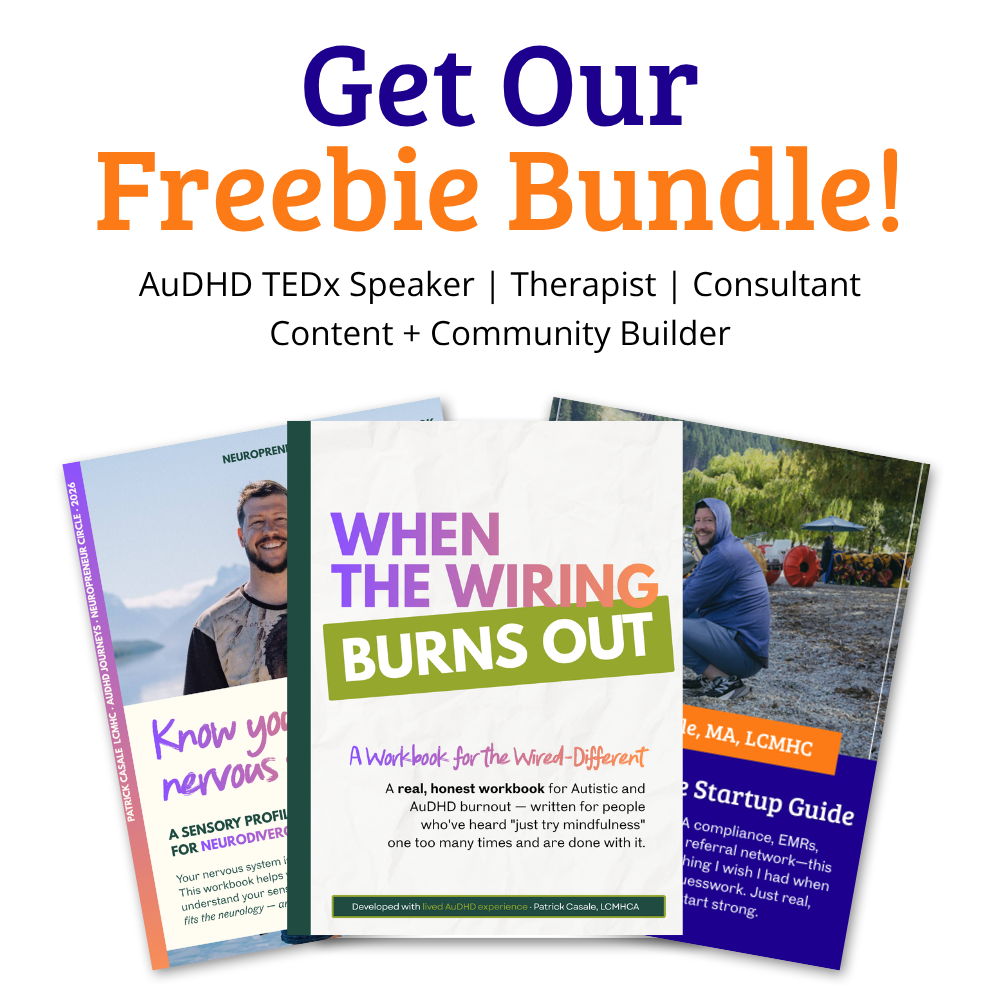
Get a practical podcasting workbook for therapists considering starting a podcast, created by Patrick Casale, host of the podcasts All Things Private Practice and Divergent Conversations.
You'll get a practical structure for therapists who want to start a podcast but don’t want to rush, perform, or build something they can’t sustain.
Grab your free copy: atppod.com/free-podcasting-workbook
✨ Move Beyond Private Practice As A Neurodivergent Entrepreneur
Move Beyond Private Practice As A Neurodivergent Entrepreneur is a FREE 5-part mini-course designed for therapists who want sustainable financial independence beyond one-on-one work.
Access your free mini-course here: atppod.com/move-beyond-private-practice-free
Transcript
PATRICK CASALE: Hey, everyone. Welcome back to the All Things Private Practice podcast. I'm joined today by Pasha Marlowe, who brings over 32 years of experience as a mental health expert to her work as a neuroinclusion speaker, consultant, and coach.
She collaborates with global organizations and institutions who value neurodiversity and neuroinclusive leadership. Pasha is the author of Creating Cultures of Neuroinclusion, has created an actionable R.E.S.P.E.C.T framework and leadership guide to support neurodiverse teams and communities.
Most importantly, Pasha leads with 55 years of lived experience as an autistic ADHDer. Welcome to the show.
PASHA MARLOWE: Glad to be here, Patrick. Thank you.
PATRICK CASALE: We've been trying to make this happen for a while.
PASHA MARLOWE: I think years, perhaps.
PATRICK CASALE: Yeah, it feels that way. Yeah, yeah. One, I mean, your work speaks for itself. If people don't follow you, they should, especially on LinkedIn, I think that's where you seem to be the most active.
PASHA MARLOWE: Yes.
PATRICK CASALE: And talking about building neuroinclusive workplaces is definitely a passion area of mine, even as a leader, and a boss, and CEO of two companies. And I think, you know, a lot of people are moving more into that direction, but also, still really struggling to figure out, like, how do we really make this as accessible as possible? And sometimes that means, like, forgetting everything that we know, my opinion. So, can you talk a little bit about why this feels like such a big passion of yours?
PASHA MARLOWE: Yeah, well, because I was a therapist and coach for so many years. I was like the meeting after the meeting. I was who people went to after a hard day of work, after needing to leave a job, after feeling burnout. And after it felt like it destroyed their sense of self. And so, I felt like I needed to help more systemically, with greater impact, by talking to the systems that were oppressing and harming the neurodivergent people I was working with.
And so, I shifted over to neuroinclusion in the workplace, which I have to say, one of the things the narrative gets wrong is that it doesn't mean how to support, attract, hire neurodivergent people. It really, to me, is very important that inclusion is actually inclusion of all people. So, it's inclusive of neurodivergent, and neurotypical people, and people who don't identify as either.
And so, I just always want to expand the conversation and keep it as inclusive as possible, and even the term neurodivergent. I make sure that that's as inclusive and expansive as possible. Because the other thing I think that people get wrong in neuroinclusion at work, is they're still mostly focused on autism, and sometimes autism ADHD, and sometimes autism, ADHD, dyslexia. And then, it pretty much stops there, the research and the work.
And that is such a disservice to the movement, as well as to the people that are already in the workplace and people who want to join. I just keep thinking how much this conversation needs to expand.
PATRICK CASALE: Yeah, that's really well said. I think that a lot of people almost use neurodivergent as a synonym for autism, ADHD, and forget that it's an umbrella term that has so many different variations, whether innate or acquired neurodivergences. And there are so much under that umbrella that I think people lose sight of that. So, if your workplace is focused on let's make this autism accessible and affirming, let's make this ADHD affirming, but you leave everyone else out, you're really not creating a neuroinclusive workplace, right?
PASHA MARLOWE: Not at all. In fact, the word inclusion itself implies that somebody in power is the person who gets to include. And so, then if it's siloed even more into, well, we're including ADHD and autistic people, you know, then the people in power and leadership are actually determining who gets to be, you know, included, who gets to be considered neurodivergent. And so, I think, that's dangerous as well over time.
PATRICK CASALE: Yeah, yeah, yeah. That's a great point. And I do some of this work. I know you do a lot of this work where you are working with organizations and kind of getting a sense of everything, right? Like I'm looking at the workflow, the hiring process, the job postings, the onboarding, the culture creation, everything and anything to see how can we make this a more inclusive environment?
And I run into sometimes, some resistance from leadership teams or ownership, where it's like, “But this is how we've always done things.” How often you run into that statement?
PASHA MARLOWE: Every week. Every week somebody will say, “This is how it's done. It's not a great system. You know, I would do it differently if it were me, but this is what works. It's a little too disruptive right now, given all that's going on the world, to try to change the whole system.” And that's an interesting perspective.
But I challenge it. I say, “Well, okay, well, how can we start to…” And I talk to therapists about this. You know, of course, therapists who are trained, and as was I in the pathology paradigm. How can we work within the system of a pathology paradigm, while also using the neurodiversity paradigm? You know, the two, how do they work together?
Same as in the workplace, you know, there's obviously capitalism, and patriarchy, and all these oppressive systems in the workplace. But that doesn't mean that as leaders and anybody who participates in the workplace can't challenge those even through language. One of my calls to action is just drop disorder from your language. Like, rather than ASD in your, you know, material, just write autism. Rather than bipolar disorder, just say bipolar. I know it's subtle.
But I feel like those subtle changes go a long way and believe people. That's one of my other calls to action, actually. Like, don't make people prove that they're suffering in the workplace, to have a need met, or to even attempt to ask for an accommodation. Like, believe them when they say who they are.
PATRICK CASALE: Yeah, yeah, that's huge. And I think that's one that feels so simple when you say it that way, right? And how often is that really done? I hear, unfortunately, from a lot of people, they'll ask for an accommodation to be met, and it's almost met with either resistance or just kind of blown off as if that's not something that we could do here.
And I think in order to make a more neuroinclusive workspace in general, and regardless of what sector or area of work you're in, it's kind of like stepping back, zooming out, and kind of looking at everything in terms of, like, how do we communicate? How do we share information? Where do we allow people to work?
The one thing that drives me fucking nuts is the black and white mentality of like, we punch a clock, we, like, come in from nine to five, and we have to be in this office space. And I always question, like, even before I knew I was autistic or ADHD, I was not a good employee, because I question everything. And my leadership staff did not appreciate that.
I would always ask, like, “If I get my work done in 10 hours, why do I have to be here for 50?” Like, “Why do I have to sit in this office all day doing nothing just to prove that I'm here?”
And there's never an answer for that. It just always defaults back to, “That's just how we do things here.” And I'm like, “But that doesn't make any sense.” Like, let's try to figure out how to support the people who have different circadian rhythms, who don't sleep well, who can't get up, and be functional at eight in the morning or nine in the morning. Like, I can't start my day typically before 10:00.
So, it's just fascinating when you start looking at that stuff. And I always think it's just so baked into this archaic mentality, and so much of it is just fear of change, and transition, and restructuring, because some leaders take that personally as if, like that is a reflection of character or intention.
PASHA MARLOWE: Yes, they get threatened by it. Sometimes, you know, are they trying to control our culture or they’re trying to control the schedule? And there's a very much a lack of agency going on there.
But I think you're spot on. You know, flexibility is one of the main needs and requests that I hear from anybody, all humans, neurodivergent, neurotypical, anybody, flexibility. Flexibility to work at different hours of the day, flexibility to have a different environment in the workplace, you know, different, obviously, lighting, different, you know, chairs, but also, different schedules and different ways of communicating.
And one of the few benefits of COVID was that we recognize that remote work is possible and could be effective. And unfortunately, a lot of people are sliding back into, obviously, hybrid, in-office. And I think they're losing a lot of people who really need the flexibility for their nervous system. I think they're losing a lot of disabled people who, you know, have exactly the skills that the workplace needs right now, with adaptability, and resiliency, and beyond. And so, yeah, I would say flexibility, clarity, and agency are three of the necessary ways that organizations can become more neuroinclusive and just more effective, in general.
PATRICK CASALE: Yeah, I agree wholeheartedly. And, you know, it's funny looking back at like, the onset of COVID and how devastating it was for the world, and just in general. I think it was really good for a lot of people whose nervous systems were really sensitive, who got sensory overloaded very easily.
I know for me, I flourished. Like, I was able to live in my home, and work in my home, and control the lighting, and the temperature, and demands.
And I also acknowledge that not everyone has that privilege to be able to do that, and it has allowed me, for sure, to be my best self in terms of being an entrepreneur, because I'm like, okay, I can get up at a time that makes sense for me. I can keep the lights, like, pretty dim or off at all times. I can control the sensory overwhelm situation in terms of, you know, maybe socializing in this social capacity. I don't have to go to meetings about meetings, which is just a fucking nightmare. And it's been really good for me.
And I think it's been good for a lot of people, but I also acknowledge that a lot of employers afterwards, and even now, were like, “No, you have to be in the office, and you have to do it this way.” And I feel like that person feels maybe trapped, or the walls are closing in, and they don't have a lot of autonomy. And without autonomy, I think it makes work feel really, really, really hard in a world that already feels hard enough.
PASHA MARLOWE: I so agree. People say, “Why are so many people identifying as neurodivergent and disabled?” One of the many pieces of, you know, research out there says 53% of Gen Z identifies as neurodivergent and disabled. I think it's more. I think most people probably would identify as neurodivergent if they knew what it meant. But, you know, I think the world is becoming more disabling, the workplace and the world itself.
And I think as we progress at this pace that isn't aligned with our nervous systems, more and more people will identify as neurodivergent and disabled, and more and more people will have more greater needs, access needs, support needs, sensory needs, that will only grow.
And so, I think the narrative of you know, Gen Z’s is too soft. It's just not accurate, obviously. But also, I think if they think, you know, Gen Z is coming in hot with neurodivergence, Gen alpha is right behind them more.
PATRICK CASALE: Yeah, yeah, yeah, absolutely, yeah. And you know, my group practice, I would say every single person is neurodivergent. How they identify typically is going to fall into the camp of ADHD, autistic ADHD, and then, other forms of neurodivergence as well. And even in that situation, knowing what I know, it's still tough and trying to always be curious and not judgmental, stealing that line from Ted Lasso about like, what accommodations do people really need? And soliciting feedback, and listening to it.
And I think a lot of leaders shy away from feedback, especially anonymous feedback, because it's hard to feel criticized. It's hard to feel like I'm not doing enough or I'm not doing it right. It's the only way we learn. It's the only way we grow.
And we have a communications Google form that just kind of overlays, like, how do we best communicate and how do I best receive information? How do I process information best? How do I like to receive feedback? How do I like to give feedback?
And when I do check-ins with staff, I'll do it virtually. I'll do it on the phone. We'll do it via text. It does not matter to me. I want to meet people where they're at, but I can also see the flip side, where people are like, “That's just so much work. That's so much energy. I just need to do it in the same way over and over and over again.”
And I can see that, I really can, but I know that you're leaving a lot of people behind if you refuse to adapt to the needs of the people who work for you and who make your business what it is.
PASHA MARLOWE: The way you speak so compassionately and respectfully with the people you work with about their needs is exactly what the respect framework I mentioned is, and that's this conversation. It's a leadership guide, but it's reciprocal, it's regenerative. You know, the leaders have needs too. The leaders might be neurodivergent as well.
And so, I think this conversation about, you know, how can I lead you? What is the best way to communicate with you? And other questions is wonderful.
And I think also, if it could be reciprocal, you know, this is how I prefer as a leader, communication. These are the sensory needs I have. And then, I believe the term is access intimacy. It's like this sense of, okay, we're both human. We all have needs. How can we understand each other more?
And then, I feel like, even though, yes, it does take time, does it also, you know, in some ways, build capacity, and opportunity, and resiliency, and so on within the team, if it doesn't feel one-sided. So, that's one of the things that I feel like has been working well, because I feel like leaders themselves feel like their needs aren't being met and their struggles aren't being recognized, and they're masking up potentially more than people on their teams. And that's exhausting for them.
PATRICK CASALE: Yeah, absolutely. One of the first things I tell new staff is in that communications forum is how I communicate and process, because I'm very direct, and I don't want that to come across in a certain way.
And I used to think, being from New York, that it was just because I was a New Yorker. And some of that still might be true, but like, I have really realized, like, I need to be very clear and transparent about what I need, how I communicate, how I show up as the owner and leader of this business. And what I don't want to have happen is for me to say something and to be taken out of context, or for it to feel really personal. So, trying really hard to just do that.
And because we have an online/hybrid-based business. Culture creation is huge, too. And trying to figure out, how can we make a bunch of different neurodivergent humans scattered throughout the southeast feel like they belong, and they are a part of, and they get to participate when they want to participate.
I always really got so frustrated that, like, forced participation in the workplace, of like, everyone has to be at this group lunch on Friday at 12:00. And it's like, no. Like, just because I'm not showing up doesn't mean I don't care about the environment. And I think just having that flexibility to opt out is really, really important. That goes for like our team meetings, our trainings. Keep your screen off, don't even show your face.
Like, we have one person that we hired via email who I've never even seen their face aside from team meetings. And I'm okay with that, because I just realized that we have to continuously evolve and adapt as a leadership team, as a culture in an organization, and continuously figure out what works and what doesn't.
And I think it's just the next iteration of what workplaces will look like in the next few years. Because, like you mentioned, we're going to see disabilities increase. We're going to see access needs increase. We are going to see people struggling increasing. Like, the acuity level is palpable in terms of state of the country, state of the world, all the stresses, all the culmination. Like, it's intense.
And just not trying to assume that anyone is ever trying to do anything wrong or damaging to the culture or workplace. I see that a lot too, and that really infuriates me.
PASHA MARLOWE: The mistrust, yeah.
PATRICK CASALE: Yeah.
PASHA MARLOWE: Yeah. And when you were speaking then about video off, one of the greatest challenges is opposing needs. So, I have a hearing disability, and I read lips. And so, for me, videos are very helpful, very, very helpful, also just energy exchange and seeing somebody's nonverbal cues. And the therapist in me is like, “Oh, what are they really like?” You know?
And so, for me, it's very helpful to have a video on to engage. And in a room, there might be somebody who doesn't feel safe turning the video on. So, then how in a remote meeting do we navigate opposing needs? Or even in a meeting room or conference where some people need, you know, softer lighting and quieter music, and some people love those strobe lights and the loud music within the same conference, you know?
And so sometimes it feels like what happens is the people who have the biggest reaction to the overstimulation, or understimulation tend to, I guess, maybe feel like that's the priority. And then, there's built resentment. And it's just fascinating. That comes up so often when I work with teams.
And that's a very challenging, complex, nuanced conversation, but I feel like it does need to be a conversation, because if you're saying in your team, you don't have to have the video on, is it also a neuro-inclusive question to say, is there anybody who, for learning or communication needs video on? And how are we going to navigate that as a team?
PATRICK CASALE: Yeah, yeah. That's a great point. So, I think it's about, like, just continuous communication, right? And continuous collective buy-in, and input, and not making unilateral decisions without really trying to get a sense of what everybody on the team needs and what their preferences are, and what their aversions are as well.
And I just think we shy away from a lot of that stuff. And it's maybe out of discomfort. Maybe it's just we don't have the time, I don't have the time in the day, and I think that's valid. Like, you know, we're grinding away a lot of the time. And it's like, I wish I had another 24 hours in this day to do the things. And so, I have a lot of compassion for people in those positions who feel like I'm trying my best and I just can't get it all done.
But I think it's also like the acknowledgement of I'm trying my best, and I'm going to continue to try to, like, adapt, and change, and integrate as we go. And it doesn't all have to happen at once.
PASHA MARLOWE: Absolutely. And in regards to the time and just capacity that people feel like they're lacking right now, when I tell leaders, you don't actually have to understand all these neurotypes, you don't actually have to understand everything about autism, and ADHD, and trauma, and on. And they're like, “What? Wait, no, I do, because we had a training on how to manage an ADHDer, how to manage somebody with PTSD.”
I was like, “Well, that's a lot. Like, that's a lot for you. What if we didn't focus on the labels, and the diagnoses, and didn't require disclosure, and had conversations about needs and preferences?”
And that's universal. You don't have to understand everything. And the relief that comes over their faces when I say that, because I think part of the narrative, especially in neuro-inclusion and neurodiversity affirming practices in the workplace, is so much like a list of this is how to accommodate an ADHDer. These are the skills of an ADHDer, for example. And then, it becomes so siloed and specific, like a therapist, or a psychiatrist, or somebody doing the diagnosis, supposedly or potentially, would need.
And so, yeah, I just feel like that's doing a disservice to the workplace, to assume that they're going to understand all the neurotypes.
PATRICK CASALE: Yeah, yeah, that's a great point as well. And you know, for a lot of us, right? So, for those of us who maybe discovered our own neurodivergence later in life, you're going to have to do a lot of learning and unlearning as well, and a lot of deconstruction of narratives that you have, core beliefs that you may have, stereotypes that you may have picked up along the way, internalized ableism. Like, there's a lot of deconstruction that goes on, and it would be foolish or naive to say, like, you should just get it. Even if you are one of the people that falls under the umbrella, you should just get it. And that's not the case a lot of the time.
PASHA MARLOWE: Yeah, there needs to be that shared responsibility. I've talked to several leaders lately, and one in particular, I'm thinking of, you know, white cis man leader, he says, “I don't get any respect everything. I say, they assume I'm being performative. They assume I'm speaking from the lens of patriarchy.” And he's like, “I have a trans kid. I adopted two immigrant kids. I have disabilities. They don't even…” This is him talking. These are his words. Like, “They don't even see me as a human. And they expect me to have these conversations with them with deep humanity, and empathy, and compassion.”
And he's like, “How can I get them to trust me as a white cis guy?” Like, it's just fascinating. So, you're right. Yeah, there's stigma and stereotyping and bias going both ways, yeah.
PATRICK CASALE: Yeah. And, you know, as a white cis man, I think about that a lot. And I think it's about how you show up, and how you have accountability, and how you talk about things, and the transparency that you have around certain topics.
I think it also comes with modeling and just showing up. And sometimes you do have to create collective buy-in by showing up and being responsible. So, it's a it's an interesting journey, but you know, again, going back to the COVID thing, one that I would not want to do any differently. And I'm really grateful for the fact that I get to do it from the comfort of my own home nine days out of 10. So, happy about that.
PASHA MARLOWE: Same, same, yes, yes. It's interesting with the COVID conversation, because one of the forms of neurodivergence that I'm seeing more and more frequently now is from long COVID and neuro-inflammation, and chronic illness, and how that impacts, obviously, the mind and body. And one's ability to go to work full time and be “productive” as if our value and worth was tied to being productive. But that's that feels like a very big part of the conversation right now, the impacts of long COVID.
PATRICK CASALE: Yeah, and I think we're just scratching the surface, you know?
PASHA MARLOWE: Yeah.
PATRICK CASALE: Who knows what that looks like in five years, 10 years from now, and what the fallout can be. So, I'm definitely someone who has dealt a lot with the impacts of the fallout of long COVID, and the brain fog, and just the energy loss, and just a constant fatigue. And it's like, damn, this is hard. So, a lot of compassion for those of you struggling with the same.
Pasha, I appreciate you coming on and making the time. And I know you are going to be speaking at our main Summit in September in Portland, and just want to give you the floor in case you want to share where people can find you, your book, or anything else that you've got going on.
PASHA MARLOWE: Thank you. Well, I am on LinkedIn every day. I enjoy writing and interacting on LinkedIn. I’m Pasha Marlowe. I'm the only Pasha Marlowe in the world. So, if you go on LinkedIn, find Pasha Marlowe. If you want to go to my website, it's www.pashamarlowe.com. And my email, pasha@pashamarlowe.com. Making it simple, keeping it simple.
And I do have a book, Creating Cultures of Neuroinclusion. Of course, the second I published it, I wanted to write all the edits and do another one. So, that's in the works, because, yeah, my autism is like, yeah, by the way, you didn't include every detail you should have. And so, I'm working on that. I'm collaborating with Nick Walker on a book on therapy and coaching for neurodivergent adults that's coming out this year, that's exciting.
PATRICK CASALE: Wow, that’s exciting.
PASHA MARLOWE: Yeah, and yeah, I'm always open to collaboration calls and just connecting. So, I'm very accessible, I think, and so I'm just hoping to have conversations with anyone out there who wants to find ways to make the world more neuro-inclusive, yeah.
PATRICK CASALE: I love it. That's amazing. And congrats on all of that. That sounds like a lot of exciting stuff in the work. So, make sure you check that book out, and then, obviously, the updated second version of that book when it comes out as well. And I get that, trust me, as I'm writing a book, I'm like, “Ooh, I didn't include every detail about this thing.” [INDISCERNIBLE 00:30:41] my editor's like, “Stop.”
PASHA MARLOWE: There's got to be a point where we stop. It's really hard, really hard.
PATRICK CASALE: It’s really hard. I'm like, someone's going to read it and be like, “But he didn't include this, and he didn't talk about this.” And it's like, that might be what a second book is foreseen. Like, these chapters cannot be 50 pages long. [INDISCERNIBLE 00:31:02].
PASHA MARLOWE: Apparently, people say that about my LinkedIn posts, too. They're like, “Or you could say that with more brevity.” I'm like, “But I love to be, you know, clear.”
PATRICK CASALE: Yeah, yeah. [INDISCERNIBLE 00:31:13]. Anyway, I appreciate that, and I'm looking forward to meeting you in person.
PASHA MARLOWE: Me too.
PATRICK CASALE: And spend time in your beautiful home city, because Portland Maine is fantastic. It reminds me a lot of Asheville, but just on the ocean and a little bit smaller. So, super cool.
PASHA MARLOWE: Yeah. Well, I'm so excited to meet you in person. Thank you so much for having me today.
PATRICK CASALE: You are welcome. To everyone listening to All Things Private Practice podcast, episodes are out on Saturdays on all major platforms and YouTube. Like, download, subscribe, share. Doubt yourself, do it anyway. See you next week.
FREE PRIVATE PRACTICE GUIDE
Join the weekly newsletter for private practice tips, podcast updates, special offers, & your free private practice startup guide!
We will not spam you or share your information. You can unsubscribe at any time.






![Episode 247: Therapy for Religious Trauma and Spiritual Abuse [featuring Michelle Moseley]](https://kajabi-storefronts-production.kajabi-cdn.com/kajabi-storefronts-production/file-uploads/sites/2147507511/images/2fcde71-1a24-73ef-244-52bcff6212f_ALL_THINGS_PRIVATE_PRACTICE_PODCAST_Episode_247.jpg)
![Episode 245: Merge Passion and Therapy: Working with Athletes, Brands, and Creatives [featuring Liz Ridgway]](https://kajabi-storefronts-production.kajabi-cdn.com/kajabi-storefronts-production/file-uploads/sites/2147507511/images/07ccf7-cd3f-6b82-d6f3-f10ba5cfd10_ALL_THINGS_PRIVATE_PRACTICE_PODCAST_Episode_245.jpg)
![Episode 244: Marketing: For Therapists Who Hate Marketing [featuring Carrie Wiita]](https://kajabi-storefronts-production.kajabi-cdn.com/kajabi-storefronts-production/file-uploads/sites/2147507511/images/068ba14-13c7-236e-e53b-bd3735f5ac73_ALL_THINGS_PRIVATE_PRACTICE_PODCAST_Episode_244.jpg)